
AI is changing how people discover and evaluate information. That part is real. But it’s not replacing the fundamentals that make SEO work: relevance, trust, and usefulness when intent is high.
An effective AI SEO strategy starts by accepting that search journeys are getting messier. People might see an AI summary, skim a few sources, then search again with a tighter question, or jump straight to a Local option when the need is immediate. In other words, AI changes the path, not the destination.
This guide is a practical framework for AI and SEO that focuses on what you can control: how you structure pages, how you build proof, and how you create content that answers real questions without sounding generic. It’s a strategy, not a tool list.
We’ll also keep the “Local vs broader” lens in view. What works for Local SEO for small businesses and near me searches is often different from what works for national content, and AI is widening that gap.
AI Overviews SEO and the Google AI Overview SEO Impact
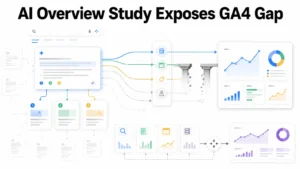
AI summaries are changing what it means to “rank.” With AI overviews of SEO, the first thing a user sees may not be a list of blue links. It’s a synthesized answer that pulls from multiple sources, often satisfying the question without a click.
That’s the real Google AI overview SEO impact: your content can influence the result without receiving a visit. So visibility and traffic are no longer the same thing. You might be “present” in the summary and still see fewer sessions than you did when traditional rankings drove clicks.
This is where AI in SEO needs a strategic adjustment. Instead of obsessing over position alone, you optimize for two outcomes:
Being cited or featured
Your content has to be easy to extract and trust: clear headings, direct answers, accurate definitions, and proof that supports claims. If you’re vague or fluffy, you’re harder to quote.
Winning the next click
Even when AI answers a top-level question, users still click for specifics: pricing, availability, comparisons, Local options, and “what do I do next?” That’s where intent capture happens.
So the goal isn’t to “beat AI.” It’s to design pages that can be summarized credibly, while also giving people a clear reason to continue the journey with you.
Local SEO vs National SEO: Strategy Splits Under AI
The quickest way to waste effort is to apply one playbook to two different problems. Local SEO vs National SEO was already a meaningful split, and AI is making it sharper.
National SEO is largely about depth and authority. You win by covering topics comprehensively, building strong entities, and earning signals that tell Google you’re a trusted source across a broad audience. AI summaries often pull from that kind of content because it’s easier to synthesize high-level explanations and “best practices.”
Local SEO, on the other hand, is about urgency and confidence. People aren’t just looking for information. They’re looking for a nearby solution they can trust. That’s why proximity, reviews, and service clarity still carry so much weight, and why near me searches often behave differently from generic queries.
From a practical standpoint, Local performance comes down to a few repeatable Local SEO tips: clear service areas, obvious contact options, Local proof, and pages that answer the questions people ask right before they call.
AI can reduce clicks on broad informational queries. But it doesn’t remove Local intent. When someone needs a dentist, plumber, or same-day delivery, they still have to choose a provider. That conversion moment is still human, still Local, and still winnable with the right strategy.
A Practical AI SEO Strategy Framework
A workable AI SEO strategy isn’t “use AI to publish faster.” It’s a repeatable system that turns research into pages people trust and act on. Here’s a simple four-part framework you can run quarterly.
1) Audience + intent map
Start with who you serve and what they’re trying to do. Map queries by intent: learn, compare, decide, buy. For Local SEO for small businesses, this usually includes urgent “near me” needs, pricing questions, and service-area confirmation.
AI can help you expand the map quickly, suggest related questions, cluster topics, and identify common objections. But you still need judgment: which intents lead to revenue, and which are just noise?
2) Entity coverage
Then define the entities you need to be “known for”: your services, locations, specialties, and differentiators. Build pages that make those entities obvious, with clear headings, consistent terminology, and internal links that connect related pages.
3) Proof assets
This is the part AI can’t fake. Proof is what makes content trustworthy: reviews, case studies, photos, certifications, data, pricing ranges, process details, and Local examples. If you want AI summaries to cite you, proof is your moat.
4) Measurement loop
Finally, set up a simple loop: publish → track → refresh. Measure not just rankings, but conversions and assisted actions (calls, forms, direction clicks, branded searches).
When you repeat this framework, you naturally move into advanced Local SEO, not as hacks, but as systemization: tighter internal linking, better page clusters, more proof, and more consistent updates across your most valuable pages.
SEO AI Agents Ideation Workflows That Don’t Produce Generic Content
The promise of SEO AI agents’ ideation workflows is speed: faster research, faster outlines, faster drafts. The risk is also obvious: faster generic content. The fix is a workflow with guardrails.
A practical, repeatable flow looks like this:
Research → clustering → outline → draft → fact-check → publish → refresh
- Research: gather SERP patterns, FAQs, competitor angles, and user questions.
- Clustering: group topics by intent (learn vs compare vs decide).
- Outline: build sections that match the reader’s decision path.
- Draft: generate a first pass, then rewrite for specificity and proof.
- Fact-check: verify claims, numbers, and tool features; remove fluff.
- Publish: ship with clear CTAs and internal links to money pages.
- Refresh: update quarterly based on performance and new query patterns.
This is where AI agents vs agentic AI matters. “AI agents” in most real workflows are tool-using loops you control: they fetch data, propose clusters, draft sections, and run checks. “Agentic AI” is the broader idea of autonomous systems making decisions end-to-end. For SEO, you want the first, not the second. You’re building assisted workflows, not handing over the steering wheel.
To make AI SEO optimization actually improve outcomes, add these guardrails:
- Lock brand voice and tone rules
- require citations or sources for factual claims
- Run SME review on anything technical or sensitive
- build anti-hallucination checks (spot vague claims, force examples, remove invented stats)
Speed is useful, but only if quality stays human.
AI Tools for Local SEO: Faster Execution, Same Fundamentals
Most AI tools for Local SEO are useful for one thing: turning messy inputs into usable outputs faster. They don’t replace fundamentals. They help you execute the fundamentals consistently.
A few practical use cases:
- GBP/Q&A ideas: generate common questions people ask before they call, then answer them in plain language.
- Review mining: summarize themes from reviews (what people praise, what they complain about) and turn that into content angles and on-page proof.
- Service-area FAQ generation: create location-specific FAQs that reflect real concerns (“Do you serve [neighborhood]?”, “How fast can you arrive?”).
- Internal linking suggestions: identify which blog posts should link to which service/location pages so authority flows to the pages that convert.
These tasks map directly to high-intent near me searches. Local intent is usually signaled through:
- near-me modifiers and “in [area]” phrasing
- clear service-area language (where you serve, not where you want to rank)
- proof placement near the decision point (reviews, turnaround times, guarantees, photos)
If you’re doing Local SEO for small businesses, the best Local SEO tips are still boring: clarity, trust, relevance, and conversion. AI just makes it easier to repeat those moves across dozens of pages without burning weeks on manual copy and analysis. The output still needs human judgment, especially when Local claims affect trust.
Retrieval, RAG, and Muvera Multi-Vector Retrieval in Plain English
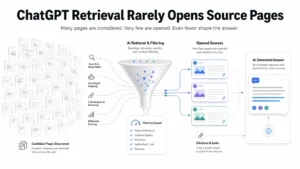
A lot of modern search isn’t “just ranking web pages.” It’s retrieval. Systems first try to find the right stuff, then decide what to show, summarize, or cite. That’s the engine behind many AI answers, and it’s why AI search SEO is becoming its own layer of thinking.
In simple terms, retrieval often works like this:
- Embeddings: content is converted into vectors so similar meanings can be matched, not just exact keywords.
- Reranking: once candidates are retrieved, another model reorders them based on relevance.
- RAG: Retrieval-Augmented Generation means the model generates answers using retrieved documents as context, rather than “guessing” from memory.
More advanced techniques like Muvera multi-vector retrieval point to an important idea: one piece of content can be represented in multiple ways (intent, entities, topics, phrasing). Multi-vector approaches can retrieve content that matches on different signals, not just one generic embedding.
What does this mean for SEO for AI search?
It rewards pages that are easy to retrieve and easy to quote:
- clean structure (clear H2s, short sections, direct answers)
- explicit entities (service names, locations, product attributes)
- strong snippets (definitions, steps, FAQs that stand alone)
You don’t “optimize for embeddings” in a mystical way. You format pages so machines can confidently extract meaning, and so humans can quickly confirm it. That’s where strategy meets page design.
What Is LLMs.txt and Does It Matter for SEO?
If you’ve been following AI search discussions, you’ve probably seen the question: What is LLMS TXT?
In plain terms, it’s a proposed file format that websites can publish to communicate preferences to AI systems, like what content is allowed for use, how it should be interpreted, or where the “official” documentation lives. It’s part of a broader push for clearer rules as AI models crawl, summarize, and cite web content.
The important part is what it can’t do. A file like this can’t guarantee compliance across every crawler or model, and it doesn’t replace the signals that actually shape visibility: your on-page content, your structure, your entities, your proof, and your reputation. Even if a platform reads it, your pages still need to be understandable, trustworthy, and worth citing.
So treat LLMs.txt as optional hygiene, not a ranking lever. If it becomes widely adopted, having it won’t hurt. But you shouldn’t build your strategy around it.
The safer mindset is still: control what you can control. Build pages that are easy to understand, easy to extract, and easy to trust, regardless of how AI systems evolve.
The Skill Stack: SEO + AI Literacy (and Why It Resembles Engineering)
The teams that execute an AI SEO strategy well aren’t the ones with the most tools. They’re the ones with a clear mix of fundamentals and measurement.
You still need classic SEO strength: intent mapping, on-page clarity, internal linking, and content that earns trust. You also need analytics discipline: knowing what to track, how to interpret drops in clicks, and how to measure assisted conversions when AI summaries reduce direct traffic.
The “new” layer is AI literacy. Not everyone needs to build models, but someone on the team should understand how retrieval works, why hallucinations happen, and how agent workflows can drift into generic output without guardrails.
If you’re building an AI search or SEO tooling in-house, it can help to understand the engineering mindset behind these systems. A related deep-dive, like how to become an AI engineer,r fits here, not because every SEO needs to code, but because AI-aware SEO increasingly resembles product and systems thinking.
Your Next 30 Days: A Simple AI SEO Strategy Sprint
A solid AI SEO strategy is a loop, not a one-time project: define intent and entities, use workflows to execute faster, publish Local-first assets, format pages for retrieval, handle governance thoughtfully, and measure what changes in real outcomes.
If you want a simple 30-day sprint, keep it tight:
- Week 1: audit your top pages for clarity, proof, and conversion. Identify where AI summaries might be stealing clicks and where near me searches still convert.
- Week 2: strengthen proof: reviews, case studies, photos, pricing ranges, and FAQs that remove doubt.
- Week 3: publish three Local assets: one Local landing page improvement, one decision-stage FAQ/pricing page, and one Local guide that supports your money page.
- Week 4: set a refresh cadence: update what performs, prune what doesn’t, and tighten internal links.
This is how advanced Local SEO becomes practical: systemization, not hacks. AI can speed output and analysis, but humans still win trust. And trust is what gets the click, the call, and the customer.
FAQs: AI SEO Strategy
What is an AI SEO strategy?
How do AI Overviews change SEO?
What’s the difference between Local SEO vs National SEO under AI?
How should I use SEO AI agents without producing generic content?
Does LLMs.txt matter for SEO?