Rankings usually slip for a simple reason: your pages get unclear. Not because “SEO is dead.” A page starts trying to answer too many queries, the headline stops matching intent, and the next step becomes hard to find.
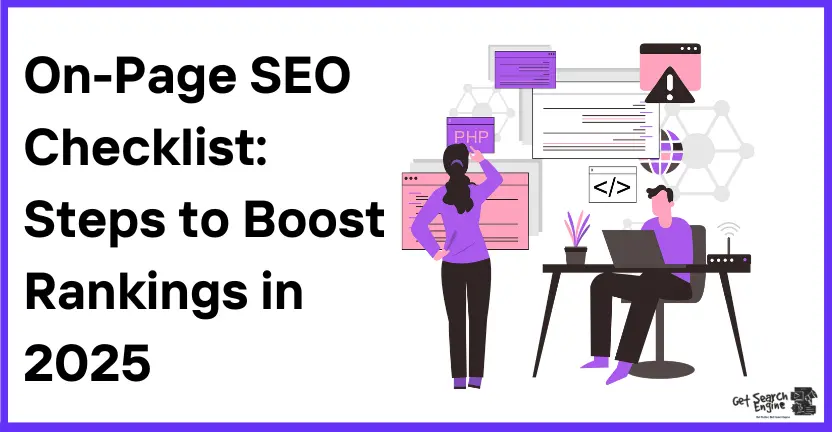
This On-Page SEO checklist is designed for the work you can actually control: titles, headings, content structure, internal links, and On-Page trust. You can run it page-by-page across service pages, local landing pages, and blog posts without rebuilding your website.
We’ll also keep it practical. You’ll learn what On-Page SEO is, what matters most, and how small fixes can improve relevance, clicks, and conversions, without a full redesign.
What Is On-Page SEO (And What It Isn’t)?
What is On-Page SEO? It’s everything you can control on the page to help search engines, and humans understand it fast: the topic, the structure, the internal links, and the clarity of the next step. In practice, the biggest On-Page SEO factors are intent match, readable headings, useful copy, and a page experience that doesn’t make people work to find answers.
It also helps to separate On Page vs Off Page SEO:
- Off-Page SEO: what the web says about you (links, mentions, reputation)
- On-Page SEO: what your page says about itself (relevance, clarity, structure, proof, action)
The point is that On-Page SEO best practices compound when you treat them like a system. If your money pages are vague, bloated, or hard to navigate, no checker can “tool” you into conversions. Clarity is the foundation.
The On-Page SEO Checklist for Any Page Type
This On-Page SEO checklist works for service pages, product pages, and blog posts because it follows the same rule: one page should do one job.
Here’s the checklist for On-Page SEO, in the order you should actually fix things:
1) Query + intent match
Start with the primary query and intent. Make sure the page answers it directly. One page, one job.
2) Title tag + H1 alignment
Your title tag and H1 should agree on what the page is about. If they don’t, Google and users get mixed signals.
3) Headings that map the decision path
Use H2s to answer the next obvious questions (pricing, process, coverage, proof, FAQs). Don’t bury the “why choose us” section at the bottom.
4) Internal links + anchor clarity
Link to relevant supporting pages and “money pages” using descriptive anchors, not “click here.”
5) Images + alt text for meaning
Use real photos where possible. Write alt text to describe what’s in the image, not to stuff keywords.
6) CTA and trust placement
Put the next step (call, quote, book) near the top, supported by reviews, badges, or proof.
Quick pass vs deep pass
- Basic On-Page SEO checklist (10 minutes): title, H1, headings, CTA
- Full pass (30–60 minutes): copy, links, proof, UX, technical cleanup
Common failure: pages try to rank for everything, and end up converting for nothing.
Content That Matches Intent (Especially on Local Landing Pages)
Most local landing pages fail for one reason: they read like they’re written for Google, not for someone ready to call. The pages that win use simple On-Page SEO techniques to answer decision-stage questions fast, including pricing range, availability, areas served, and proof that you’re a real option nearby. Those are the On-Page SEO factors that turn “visibility” into leads.
A mini-template that works across industries
- Above-the-fold clarity (service + location + primary CTA)
- Proof (reviews, photos, turnaround time, badges)
- Details (what you do, what’s included, common jobs)
- FAQs (coverage, pricing, timing, process, objections)
- CTA (repeat one main action)
This also connects to site architecture. When you build a website for a local business, you need clean service pages and strong location pages, then internal links between them so Google understands relationships and users can move naturally:
Service → Area page → Book/Call
A good Local structure makes both ranking and conversion easier.
Technical On-Page SEO That Improves Rankings and Conversions
You can nail the copy and still lose leads if the page is slow, confusing, or duplicated. That’s where technical On-Page SEO matters, only the parts that consistently impact crawling and user behavior.
Indexability basics (from your On-Page SEO audit checklist)
- Avoid accidental duplicates (near-identical pages competing with each other)
- Use canonicals where needed, so Google knows which version to rank
- Make sure important pages are actually indexable (no “noindex” surprises)
Page speed + core UX basics
Slow pages spike bounces, especially on mobile, which directly weakens the On-Page SEO factors that matter most: engagement and conversion.
A schema that supports meaning
Use schema only where it helps clarify context, LocalBusiness, Product, FAQ, not as a ranking trick.
Website accessibility as quality
Bake in website accessibility:
- Clear heading hierarchy
- Readable contrast
- Keyboard-friendly forms
- Descriptive alt text
Technical polish doesn’t just “help SEO.” It reduces friction, improves trust, and makes it easier for both Google and users to understand your page and take the next step.
On Page SEO Tools and How to Run a Real Audit
On-Page SEO tools are useful, but only if you treat them like diagnostics. They can surface issues fast, missing titles, thin content, broken links, duplicate tags, but they can’t tell you which fixes will move revenue. Priorities come from intent and business value.
Quick triage vs deeper audits
- Free On-Page SEO checker (quick scans):
Missing title? Broken headings? Page blocked? Oversized images? - Full On-Page SEO audit:
Crawl the site, map internal linking, find cannibalization, and spot template-level issues across categories, service pages, and local landing pages.
When you compare the best On-Page SEO tools, don’t over-index on “features.” Choose tools that help you answer:
- Which pages matter most?
- What’s broken at scale?
- What’s preventing conversion after the click?
Also, remember: SEO doesn’t sit alone. A real audit lives inside your stack of essential digital marketing tools, Analytics for outcomes, heatmaps for behavior, CRM for lead quality, and email for follow-up. Tools spot issues. Systems turn fixes into results.
How to Monitor On-Page SEO Changes with Digital Analytics
On-Page improvements only matter if you can prove what changed. Rankings are useful, but Digital Analytics should also track CTR, scroll depth, form starts, calls, and bookings.
Start with a clean Google Analytics account setup, then make sure Google Analytics data collection is correct: key events, conversions, and phone-click tracking (especially on Local service pages).
In GA4, a few GA4 dimensions and metrics tell most of the story:
- source/medium
- landing page
- device
- conversion rate
Then layer in landing page optimization using heatmaps. Heatmaps reveal friction that SEO tools won’t:
- CTA blindness
- rage clicks on non-clickable elements
- form drop-offs
- sections nobody scrolls to
That’s often where the fastest conversion wins live, right after you earn the click.
A Repeatable On-Page SEO Checklist Routine
A reliable On-Page SEO checklist is a system, not a one-time cleanup:
clarify intent → fix structure → strengthen internal links → improve UX/accessibility → measure
If you want this to compound, set a simple cadence: optimize 2–5 pages per week, starting with your highest-converting pages and your most important local landing pages. Those pages usually create the fastest lift in calls and leads.
The core idea behind On-Page SEO best practices is boring, but true: the best On-Page SEO optimization tool is consistency, small improvements repeated every month.
FAQs: On-Page SEO Checklist
1) What is On-Page SEO?
2) What’s included in an On-Page SEO checklist?
3) How is On-Page SEO different from Off-Page SEO?
4) How often should I run an On-Page SEO audit?
5) How do I measure On-Page SEO improvements in Google Analytics?