
Search is changing again. But this time, the “result” is often an answer. Not a list of links. That’s why generative engine optimization matters. GEO helps your content show up inside AI-generated answers. It’s the upgrade layer on top of SEO. You still want rankings. But now you also want mentions, citations, and accurate brand positioning inside tools like ChatGPT, Google AI surfaces, and Perplexity.
1) Search changed. Attribution got harder.
Here’s the shift you can’t ignore:
- Users ask longer, messier questions now.
- AI summarizes first. Links come later.
- Many clicks never happen at all.
- The “winner” is the source AI trusts.
- Generative AI search engine optimization is about becoming that source.
This GEO playbook will show you how to make your pages easy to extract, safe to cite, and hard to ignore, using content, technical, and authority moves you can actually execute.
2) What is Generative AI? (Meaning + definition)
Generative AI is AI that creates new content. It can write text, make images, generate code, or summarize information. That’s the simple generative AI meaning.
Here’s the clean generative AI definition:
Generative AI uses patterns learned from large datasets to produce new outputs that look human-made.
Most generative AI models work like this:
- They take your prompt as input.
- They predict the most likely next words.
- They keep predicting until an answer forms.
- They can also pull facts from sources (RAG).
- They often rewrite information in their own words.
This matters for search because AI doesn’t “rank” the same way. It synthesizes. It picks a few sources it trusts, then builds an answer. If your content is clear, structured, and backed by evidence, it’s easier to pull into that answer.
Quick reality check:
If your page can’t be cleanly quoted, it won’t be cited.
3) What is GEO (Generative Engine Optimization)?
Generative Engine Optimization (GEO) is the practice of optimizing your content so it gets selected, summarized, and cited inside AI-generated answers. That’s the core idea behind generative engine optimization.
Traditional SEO focuses on rankings and clicks. GEO focuses on being the source. In other words, generative engine optimization AI is about training AI systems to “trust” your pages when they build answers.
Here’s what AI generative engine optimization tries to improve:
- Mentions: your brand or product gets named.
- Citations: your page becomes a referenced source.
- Accuracy: the AI explains you correctly.
- Coverage: you show up across many prompts.
- Consistency: your message stays the same everywhere.
So, is GEO replacing SEO? No. GEO sits on top of SEO. If your site is slow, confusing, or blocked for bots, you’ll struggle in both.
The big shift is how content gets chosen. AI systems favor content that is:
- Easy to extract and summarize.
- Clear on definitions and facts.
- Strong on entities (people, brands, products).
- Supported by proof (data, examples, experience).
That’s why generative AI search optimization is less about “ranking tricks” and more about clarity + trust.
4) How AI search “decides” what to cite (entities + retrieval)
Generative engines don’t “crawl and rank” like old-school search. They try to understand, then retrieve, then compose. This is the part most people miss in generative AI search engine optimization.
Here’s the simplified flow:
- Step 1: Interpret the question
The model breaks your query into sub-questions. This is why long prompts still work. - Step 2: Retrieve supporting sources
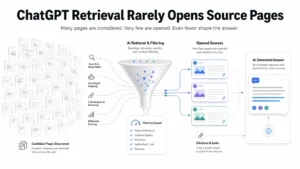
Many systems use retrieval (often called RAG). They pull chunks from pages that look relevant and reliable. - Step 3: Build an answer + choose citations
The model prefers sources that are easy to extract, consistent, and specific.
The real lever is entities. Entities are “clean nouns” the AI can identify.
Examples: Netskope, Contentful, generative engine optimization, Schema.org, Wikipedia.
If your content clearly explains:
- what the entity is
- what it does
- how it relates to other entities
…you become easier to use in answers.
What gets cited more often in generative AI SEO optimization?
- Pages with direct definitions near the top
- Sections with one clear idea per heading
- Lists and tables (AI loves structured comparisons)
- Proof signals: original data, screenshots, quotes, author credibility
- Consistency across the web (same brand facts everywhere)
If your content is vague, AI won’t risk citing it.
5) Benefits: Why GEO matters
If you only chase rankings, you’re playing half the game. Generative engine optimization is about winning visibility inside the answer, where users are spending more time now.
Here are the practical generative AI SEO optimization benefits you’ll actually notice:
- More discovery with fewer clicks needed
Even when users don’t click, they still see your brand and your POV. - Trust at scale
A citation in an AI answer works like a mini endorsement. It’s social proof, automated. - Higher-quality demand
People who do click after seeing AI summaries are usually deeper in research mode. They convert better. - Stronger positioning control
GEO helps reduce wrong or mixed messaging by making your “official” answers obvious and repeatable. - Compounding visibility
Once AI systems treat your domain as a reliable source, you tend to show up again for related questions.
Net: generative AI SEO optimization isn’t just traffic defense. It’s brand and demand growth, on new search surfaces where competitors are still sloppy.
6) Playbook Pillar 1, Content
GEO Content Playbook: write content AI can lift and trust
If you want generative engine optimization to work, your content must be easy to extract. And safe to cite. That’s the heart of generative AI search optimization.
6.1 Write in “answer-first” blocks
AI loves pages that resolve the question fast.
Do this:
- Use question-based H2/H3s: What is…, How does…, Why does…
- Put a direct 1–2 sentence answer right under the heading.
- Then add depth: examples, steps, edge cases.
Mini template you can reuse
- Heading: What is X?
- Direct answer (2 lines): X is… It helps by…
- How it works (bullets): Step 1… Step 2…
- Proof: stat, quote, screenshot, or mini example
- Internal link: “Related: X vs Y”
This style wins in generative AI search engine optimization because it’s clean and quotable.
6.2 Chunk your content like a machine would
One heading = one idea. No mixed paragraphs.
Do this:
- Keep paragraphs short (2–4 lines).
- Use lists for steps, features, pros/cons, and comparisons.
- Add a small table when you can. AI extracts tables easily.
Avoid this:
- Long intros that “set the vibe”
- Hidden answers buried after 10 lines
- One section covering five topics
6.3 Add proof signals (or you’ll sound generic)
AI systems prefer content that feels verified.
Add:
- Original data points (even small ones)
- Real screenshots (tools, dashboards, workflows)
- First-hand lines like: “We tested…”, “In our audit…”
- Clear author info (name, role, experience)
This is where generative AI optimization separates real brands from AI-fluff sites.
6.4 Build entity-first topical clusters
GEO rewards clarity around entities (brands, products, concepts).
Do this:
- Create 1 pillar page (big topic) + 6–12 support pages (subtopics)
- Interlink aggressively with descriptive anchors
- Define your entity once, then stay consistent everywhere
Quick GEO content checklist
- Can my answer be quoted as-is?
- Is each section one clear idea?
- Do I have proof, not opinions?
- Are entities named clearly and consistently?
- Do I link to deeper supporting pages?
7) Playbook Pillar 2, Technical
GEO Technical Playbook: make your content retrievable
Content is useless if AI bots can’t fetch it. AI generative engine optimization starts with one boring truth: if you block access, you don’t exist.
7.1 Make sure AI bots can crawl you
First, confirm you’re not accidentally blocking crawlers in:
- robots.txt
- CDN/WAF rules (Cloudflare, Akamai, etc.)
- login walls or geo blocks
- weird parameter traps
What “good” looks like
- Your sitemap is reachable.
- Core templates return 200 status codes.
- Important pages aren’t noindexed by mistake.
If your site has strict security rules, allowlist legitimate bots carefully. Don’t nuke access blindly.
7.2 Don’t hide critical content behind JavaScript
Many AI crawlers fetch HTML but don’t reliably render JavaScript. If your key content loads only client-side, it may be invisible.
Do this for critical pages:
- Pricing, product, docs, category pages
- Core blog posts and glossary pages
Best options:
- Server-side rendering (SSR)
- Static generation (SSG)
- Prerendering for bots
This is one of the highest ROI fixes in generative engine optimization AI.
7.3 Use structured data to remove ambiguity
Schema won’t magically “rank” you in AI answers. But it helps reduce confusion about:
- who wrote the content
- what the page is about
- what your organization does
High-impact schema types:
- Organization
- Article / BlogPosting
- Person (author)
- FAQ (only when it’s real Q&A)
- Product (for ecommerce)
Think of schema as “labels” that make your meaning harder to misread.
7.4 Make media understandable (multimodal basics)
AI is getting better at images and video, but text still anchors understanding.
Do this:
- Write descriptive alt text (what + why it matters)
- Add video transcripts
- Use clear filenames and captions where relevant
7.5 Performance still matters (for users and bots)
Fast pages get crawled more efficiently and fail less often.
Priorities:
- Reduce TTFB on key templates
- Avoid heavy third-party scripts
- Keep pages stable (no layout shifts)
Technical punchline:
If your content can’t be fetched quickly and cleanly, generative AI search engine optimization won’t save it.
8) Playbook Pillar 3, Authority
GEO Authority Playbook: become a “safe source” across the web.
AI models don’t trust your website in isolation. They learn from the broader internet. That’s why generative engine optimization needs authority signals outside your domain too.
8.1 Earn mentions in places AI already trusts
If your brand shows up repeatedly across credible sources, you look “safer” to cite.
High-leverage mention sources:
- Industry publications and guest features
- Partner pages and integration listings
- Podcasts, webinars, conference recaps
- Community threads (Reddit, Quora, Stack Overflow, niche forums)
- GitHub docs (if you’re technical)
You’re not chasing backlinks for PageRank here. You’re building corroboration for AI.
8.2 Keep your brand facts consistent everywhere
Inconsistent messaging creates AI confusion. And confusion kills citations.
Standardize these across your site + profiles:
- Brand name spelling
- Product names and categories
- One-liner description (what you do)
- Key differentiators
- Location(s), founding year, leadership (if public)
If your “About” page says one thing and your LinkedIn says another, AI can mix you up.
8.3 Strengthen your entity footprint (owned profiles)
Owned profiles help reinforce legitimacy.
Prioritize:
- A solid About page on your site (with clear entity definitions)
- Wikipedia/Wikidata (only if you qualify; don’t force it)
- Crunchbase / G2 / Capterra (where relevant)
- Google Business Profile (local brands)
For enterprise generative AI buyers, these surfaces matter even more. They signal trust.
8.4 Build “citation-worthy” pages (your authority magnets)
Some pages get cited a lot because they’re built like reference material.
Create:
- Glossary pages (clean definitions)
- Statistics pages (dated + sourced)
- Comparison pages (tables win)
- “How it works” explainers
- Integration/setup documentation
These pages support generative AI search engine optimization because they are easy to extract and hard to misinterpret.
Authority punchline:
You don’t “convince” AI with branding.
You convince AI with consistent proof across many trusted places.
9) Agentic vs Generative AI (and why it changes GEO)
People mix these up. Don’t. The difference affects how you approach generative engine optimization.
Agentic vs generative AI: the simple difference
- Generative AI creates outputs (answers, summaries, drafts).
- Agentic AI takes actions (it can plan steps, browse, compare options, call tools, and complete tasks).
So when generative AI software is used as an “agent,” it doesn’t just explain. It tries to decide and do.
Why this matters for GEO
If the AI is acting like an agent, it needs content that supports decisions, not just definitions. That means your pages must include:
- Clear constraints: pricing ranges, eligibility, regions served, return policy
- Step-by-step workflows: setup steps, implementation, “how to choose” logic
- Comparison-ready details: X vs Y tables, pros/cons, best-for scenarios
- Exact specs: integrations, requirements, limits, compatibility
- Trust anchors: author identity, last updated date, sources, proof points
The GEO takeaway
GEO used to be “get cited in answers.”
Now it’s also “be the page an agent can rely on to take the next step.”
If your content is vague or marketing-only, agents will skip it. If your content is precise and structured, you become the default source.
10) Tool stack: GEO tools, platforms, and software
Best AI tools for generative engine optimization (how to choose).
There’s no single “winner” tool here. The best AI tools for generative engine optimization depend on what you’re trying to measure: mentions, citations, prompt coverage, or crawl access. So instead of chasing “shiny” dashboards, build a lean stack that maps to your GEO workflow. (Semrush)
10.1 Pick tools by job-to-be-done (not brand name)
Here’s the practical breakdown most teams use:
- AI visibility + citation tracking (GEO tracking)
Use these to measure presence across generative AI platforms (ChatGPT, Google AI surfaces, Perplexity, etc.), and compare share-of-voice vs competitors. Examples: Semrush AI Visibility products, Ahrefs Brand Radar, Profound, Otterly (prompt-level tracking). (Semrush) - Core SEO + indexing signals
These aren’t “GEO tools,” but they still drive generative AI search engine optimization outcomes: Google Search Console, Bing Webmaster Tools, crawl audits, log checks. - Content QA + validation platforms
Use generative AI tools (ChatGPT, Perplexity, Gemini) to test: “How does AI describe us?” and “Which sources are cited?” Treat this as a QA loop, not a content generator.
10.2 How to evaluate “best generative engine optimization brands for AI”
Use this scorecard:
- Covers multiple engines (not just one) (Ahrefs)
- Tracks prompts + citations over time (Semrush)
- Lets you segment by topic/use case (so you can act on insights)
10.3 Don’t ignore bot access tooling
If you want AI visibility, verify you’re not blocking key crawlers (and that you’re using the right user-agent guidance). OpenAI, for example, documents how to manage search opt-outs via specific bots. (OpenAI Developers)
Net: your AI SEO tools generative engine optimization stack should help you measure visibility, fix retrievability, and tighten your message, fast.
11) Measurement: track what AI doesn’t show in GA4
GEO is annoying to measure because a lot of visibility happens without a click. So if you only track traffic, you’ll think nothing is working. You need a visibility layer on top of SEO metrics.
How to measure generative engine optimization?
What to track (the GEO scorecard):
- Brand mention rate: % of important prompts where your brand is named.
- Citation rate: % of prompts where your site is cited as a source.
- Citation quality: are they citing the right page (pricing/docs/guide)?
- Share of voice: how often you’re cited vs competitors.
- Consistency: is the AI describing you correctly?
- GSC signals: impressions and query mix shifts (even if clicks drop).
- Bot access: AI-bot hits, blocks, 4xx/5xx errors in logs.
How to set it up (simple process):
- Build a list of 30–50 “money prompts” (what buyers ask).
- Snapshot results weekly (answer + citations + position in answer).
- Log changes you ship (content, internal links, SSR, schema).
- Review deltas every 2 weeks and repeat what moved metrics.
If your goal is generative AI SEO optimization, this is how you prove impact without relying on clicks.
12) Conclusion + quick checklist CTA
Generative engine optimization isn’t a “new channel.” It’s a new way your content gets chosen. If AI can’t retrieve your page, extract your answers, and trust your claims, you won’t get cited, no matter how good your copy sounds.
The win is simple: be the safest, clearest source on your topic.
Quick GEO Checklist (use this as your weekly audit)
- Crawlable: AI bots can access key pages + sitemap
- Renderable: critical content is visible in server-side HTML
- Answer-ready: direct answers under H2/H3, not buried
- Entity-clear: you name people/products/terms consistently
- Proof-backed: data, examples, screenshots, author credibility
- Schema-supported: used to remove ambiguity (not “hack” rankings)
- Authority-built: consistent brand info + mentions on trusted sites
- Measured: mention rate, citation rate, share-of-voice tracked weekly
If you want a fast start: run a 14-day GEO sprint, pick 10 priority pages, apply the content + technical fixes, then track citations across your top prompts. That’s how you turn GEO from theory into outcomes.
13) FAQs on Generative Engine Optimization (GEO)
What is generative engine optimization?
Why is generative engine optimization important?
Is generative engine optimization the same as traditional SEO?
Is answer engine optimization and generative engine optimization same?
How to do generative engine optimization?
What’s the best generative engine optimization strategy for AI?
Does generative engine optimization work for all types of websites?
How to measure the success of generative engine optimization campaigns?
Is generative engine optimization the future of digital marketing?