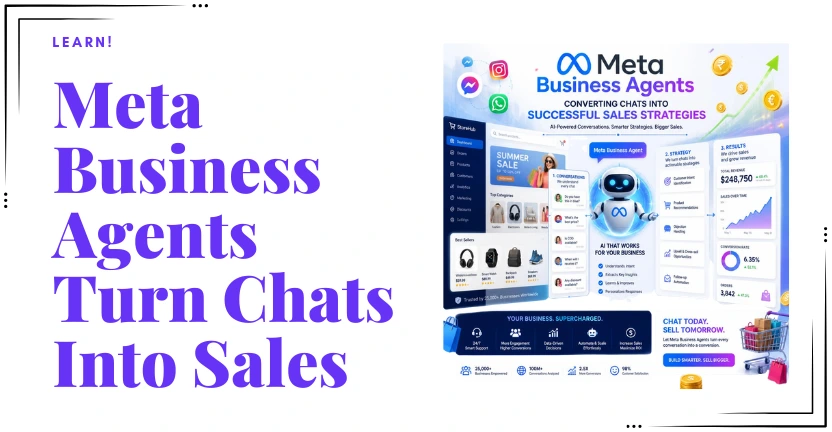
Meta Business Agents are designed to help companies manage customer conversations, product discovery, lead qualification and purchases inside Meta’s messaging platforms. The development could make WhatsApp and Instagram more important parts of the complete customer journey.
What exactly did Meta introduce?
Meta introduced a new generation of AI-powered agents for businesses at Meta Conversations 2026.
These systems go beyond traditional chatbots.
A traditional chatbot usually follows a set of predefined rules. It may answer basic questions, show a menu or send the user to a human support agent.
Meta Business Agents are designed to understand context and manage longer conversations.
According to demonstrations reported from the event, the agents can:
- Answer support questions
- Qualify potential leads
- Check current inventory
- Recommend products
- Share order updates
- Support appointment booking
- Guide users toward checkout
- Maintain a company’s brand voice
They can also use API connections and business information to provide more accurate answers.
The wider goal is to let businesses handle more sales and service activity directly inside WhatsApp, Messenger and Instagram Direct.
How is this different from a chatbot?
Most older chatbots depend on fixed flows.
For example:
- The user chooses a topic.
- The bot shows several options.
- The user selects one.
- The bot gives a standard response.
That approach works for simple questions, but it can feel restrictive.
Customers do not always describe a problem using the same words. They may ask follow-up questions, change their mind or combine several requests in one conversation.
An AI agent can use the previous messages to understand what the customer is trying to achieve.
A customer might say:
I need a gift for my sister, but I want something under ₹2,000 and it must arrive before Friday.
A well-configured agent could potentially:
- Understand the occasion
- Apply the budget
- Check delivery timing
- Search available products
- Recommend suitable options
- Answer follow-up questions
- Help complete the order
The conversation feels closer to speaking with a sales assistant than navigating a fixed chatbot menu.
Where can customers find businesses?
Meta is also improving business discovery within WhatsApp.
Users may be able to find businesses through the WhatsApp search bar and begin a conversation without first visiting the company’s website.
Search Engine Land reported that Meta confirmed improved discovery features for finding businesses directly within WhatsApp.
This creates a new kind of search behaviour.
A customer may discover a company, ask questions, compare products and complete a purchase without opening a traditional browser.
That does not make websites unnecessary.
A website will still provide:
- Detailed information
- Search visibility
- Landing pages
- Trust signals
- Analytics
- Content
- Policies
- A broader shopping experience
However, some customers may complete much more of their journey inside messaging apps.
Marketers therefore need to think beyond website traffic as the only measure of digital visibility.
Why should marketers care?
The biggest change is that discovery, consideration and conversion may happen in one conversation.
In a traditional journey, the customer may:
- Search on Google.
- Open a website.
- Browse several pages.
- Leave.
- See a retargeting advertisement.
- Return later.
- Contact support.
- Complete the purchase.
A messaging-based journey could be much shorter.
The customer may:
- Find the business in WhatsApp.
- Ask for a recommendation.
- Compare options.
- Confirm availability.
- Complete the purchase.
This reduces friction.
It also changes what marketers need to optimise.
The important assets may include:
- Product feeds
- Prices
- Inventory
- Delivery information
- Business descriptions
- Frequently asked questions
- Brand voice instructions
- API connections
- Human escalation rules
- Conversation reporting
A strong website alone may not be enough if the information inside the messaging agent is incomplete or outdated.
How could this affect ecommerce?
Ecommerce brands may use agents as digital sales assistants.
The agent could help customers find products based on:
- Budget
- Size
- Colour
- Occasion
- Availability
- Delivery date
- Product features
This is especially useful when customers need guidance rather than a simple product search.
For example, choosing a saree, camera, gift, travel package or insurance product often requires several questions.
An agent can narrow the options while keeping the customer inside the conversation.
Brands may also use agents for:
- Abandoned purchase follow-ups
- Order updates
- Product education
- Cross-selling
- Customer support
- Repeat purchases
- Personalised promotions
However, businesses need to be careful with personalisation.
Recommendations should be useful and transparent. Customers should not feel manipulated or pressured.
How could this affect lead generation?
The agents are not limited to ecommerce.
A service business could use them to:
- Ask qualification questions
- Identify the required service
- Collect basic contact details
- Suggest an appointment time
- Share location information
- Route high-value leads to a person
This may help businesses respond outside normal working hours.
It may also reduce the time sales teams spend answering repetitive questions.
The agent should not replace a person in every situation.
Complex, sensitive or high-value conversations may still require human judgement.
A good system needs clear rules for when the AI should transfer the conversation.
Why does data quality matter?
An AI agent is only as reliable as the information it receives.
Meta’s system can learn from a company’s Meta channels and website. Businesses can also provide information such as product pricing and inventory. They can define tone, availability and how the agent should represent the business.
If that information is wrong, the agent may give wrong answers at scale.
Potential problems include:
- Recommending unavailable products
- Sharing an old price
- Promising an impossible delivery date
- Giving incorrect policy information
- Using an unsuitable tone
- Failing to recognise when human help is needed
This can damage trust quickly.
Before activating an agent, businesses need a reliable source of truth.
That source may include:
- Product catalogue
- Inventory system
- Pricing database
- Delivery rules
- Refund policy
- Store locations
- Support documents
- Approved promotional offers
The information should have a clear owner and update process.
What control will businesses have?
Control is likely to be one of the biggest factors affecting adoption.
Businesses need to know what the agent is saying to customers.
The reported system includes tools that can allow companies to:
- Monitor active conversations
- Move selected chats to a person
- Provide feedback
- Define instructions
- Control tone
- Set active hours
- Decide how the agent sells or represents products
These controls are important because full automation without review can create brand and customer-service risks.
Marketers should not treat the agent as a tool they configure once and forget.
It needs ongoing training, testing and review.
What is the wider context?
Messaging platforms have been moving toward commerce for several years.
Businesses already use WhatsApp and Instagram Direct for:
- Product questions
- Customer support
- Order updates
- Lead generation
- Appointment booking
- Informal selling
AI agents make these existing behaviours more scalable.
The update also reflects a wider movement toward agentic commerce.
Technology platforms want AI systems to do more than answer questions. They want them to help users compare options, make decisions and complete tasks.
Google is also connecting AI search with shopping, business information and checkout experiences. Meta’s advantage is its access to messaging conversations and large business communities across WhatsApp, Instagram and Facebook.
The result is a customer journey that may become less dependent on individual websites and apps.
What should marketers do next?
Businesses should prepare their information before focusing on automation.
Audit common customer questions
Review messages, support tickets and sales conversations.
Identify:
- Common questions
- Common objections
- Product comparison needs
- Delivery concerns
- Pricing questions
- Reasons customers ask for a person
Clean product and business data
Make sure prices, availability, descriptions and policies are accurate.
Define the brand voice
Write clear rules for:
- Tone
- Greeting style
- Product claims
- Discounts
- Sensitive questions
- When to avoid making a recommendation
Create escalation rules
Decide when the AI must transfer the conversation to a human.
Examples include:
- Complaints
- Refund disputes
- Complex technical issues
- High-value negotiations
- Sensitive personal information
- Uncertain answers
Plan measurement
Track more than the number of messages.
Useful measures may include:
- Qualified leads
- Purchases
- Appointments
- Conversation completion
- Escalation rate
- Customer satisfaction
- Incorrect-answer rate
- Revenue from messaging
Test before scaling
Start with a limited set of products or customer questions.
Review conversations regularly and improve the instructions.
What happens next?
Marketers should watch how widely Meta makes Business Agents available and what integrations are supported.
Important questions remain:
- Which countries will receive access?
- What will the feature cost?
- Which business accounts will qualify?
- How will customer data be handled?
- What reporting will be available?
- Which payment and commerce systems will connect?
- How easily can companies train the agent?
- How will mistakes be managed?
The direction is clear even if the full rollout details are not.
Messaging apps are becoming places where customers can discover, evaluate and buy from businesses.
Brands that maintain accurate data and design useful conversations will be better prepared than those that treat WhatsApp only as a customer-support inbox.