Disclaimer: The reviews and comparisons in this article reflect our independent professional opinions and are provided for informational purposes only. We have aimed to remain objective and unbiased. Nothing here is intended to disparage or defame any company or product. Readers should conduct their own due diligence and verify details via official sources.
Most comparisons turn into feature dumps. That doesn’t help when you’re actually deciding.
Both SEMrush and Ahrefs cover the SEO basics, including keyword research, competitor research, rank tracking, backlink analysis, and site audits.
The real question is fit: which platform matches your workflow, your team setup, and what you need the tool to do every week.
This is a 10-minute comparison built for buyers who want clarity. We’ll compare SEMRush vs Ahrefs across 10 practical parameters (use-case, data, audits, links, reporting, integrations, security, pricing), using short, decision-focused pointers instead of long explanations.
1) Use-case fit
| Pointer | SEMRush | Ahrefs |
| Core strengths | Broad marketing suite: SEO, competitive research, ads, content, social, and local tools. | Search-focused platform with strong backlink data, keyword research, content exploration, and site audits. |
| Best-fit team | Teams needing one platform for SEO plus PPC and cross-channel reporting dashboards. | SEO teams prioritizing backlink analysis, competitor research, and fast keyword-driven content decisions. |
| Primary workflows | Keyword research, competitor benchmarking, site audits, rank tracking, paid search insights, and reporting. | Backlink prospecting, content gap discovery, keyword analysis, rank tracking, site audits, and research. |
| Scale & scope match | Works well for multi-team marketing operations needing varied toolkits across regions and channels. | Fits SEO-led orgs managing multiple sites, when search data depth matters most. |
| Differentiators | Adds PPC, social, local, and content workflows alongside core SEO toolset modules. | Known for intuitive interface and strong link and keyword research for search discovery. |
2) Scale & multi-property support
This is where “enterprise-ready” gets real: multiple sites, multiple markets, and many users. Most limits depend on the plan tier, so the question is how gracefully each tool scales.
| Pointer | SEMRush | Ahrefs |
| Maximum scale handled | Handles many projects; limits depend on plan, with add-ons for scaling enterprise. | Project limits vary by plan; large crawls and tracking need higher tiers. |
| Multi-domain / multi-brand management | Organizes multiple domains in one account; separate projects plus cross-project reporting views. | Supports multiple projects per account; each domain tracked separately for clarity too. |
| Multi-market support | Position Tracking supports locations and devices; strong for local and global SEO. | Rank Tracker supports country and device views; finer local granularity may vary. |
| Seats + permissions at scale | Multiple user seats available; roles and permissions improve collaboration on larger teams. | User seats scale by plan; permissions exist, but enterprise controls can differ. |
| Organization & segmentation | Tags, lists, and dashboards help segment keywords, pages, and markets at scale. | Projects, filters, and reports segment keywords and pages; dashboards are simpler overall. |
3) Data quality & freshness
The “better” dataset is the one that stays fresh in your markets, for your workflows.
| Pointer | SEMRush | Ahrefs |
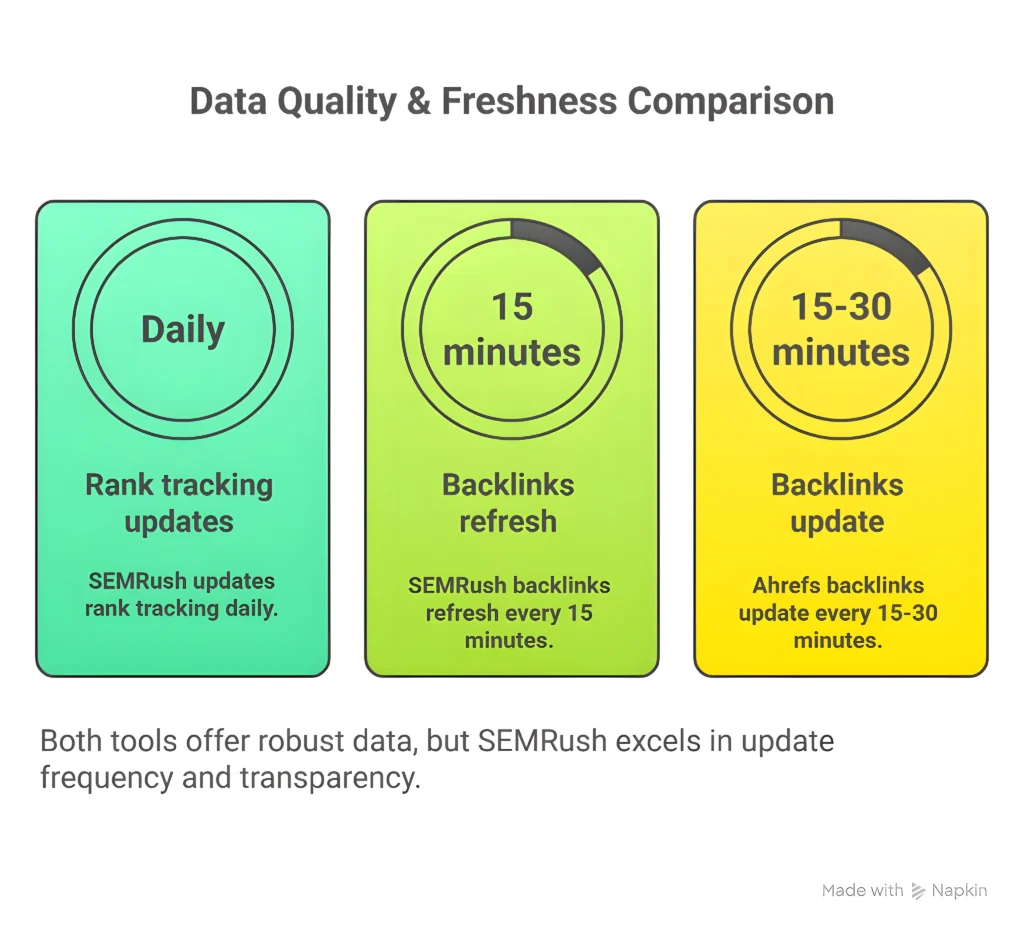
| Update frequency | Rank tracking updates daily; backlinks refresh every 15 minutes; keywords vary by demand. | Backlinks update every 15–30 minutes; keyword volumes refresh every few weeks, monthly. |
| Dataset coverage | Broad datasets across keywords, backlinks, and traffic intelligence; coverage differs by country database. | Large keyword index across 200+ locations, plus extensive backlink and crawl data. |
| Accuracy & consistency | Good directional accuracy; keyword and traffic estimates can differ from GA4 and GSC. | Strong link crawling consistency; search volume and traffic estimates still require real analytics checks. |
| SERP feature coverage | Position Tracking reports many SERP features and visibility shifts; updated daily per campaign. | Rank Tracker includes SERP features filters, showing where you rank inside features. |
| Data transparency | Explains Live Update and database methods; shows last-update timestamps in projects clearly. | Help docs detail index refresh rates and metric updates for links and keywords. |
4) Keyword research & intent
This is where most buyers spend the most time, especially for content-led SEO.
| Pointer | SEMRush | Ahrefs |
| Keyword discovery depth | Keyword Magic Tool generates huge lists, groups by topic, filters fast easily. | Keywords Explorer surfaces matching terms, questions, and related keywords across many locations. |
| Intent signals | Shows intent labels in Keyword Magic Tool; supports intent-based filtering and planning. | Uses SERP-based cues and Parent Topic to infer intent and page scope. |
| Difficulty & competitiveness | Keyword difficulty score plus SERP analysis helps estimate ranking effort for keywords. | Keyword Difficulty estimates ranking effort using referring domains pointing to top pages. |
| Clustering & topic mapping | Keyword Strategy Builder uses AI to cluster keywords into topics and pages. | Parent Topic and SERP overlap help group keywords and avoid cannibalization issues. |
| Opportunity finding | Competitive gap tools highlight missing keywords, prioritize by volume, difficulty, and intent. | Content Gap and traffic potential identify wins beyond one keyword’s volume alone. |
5) Rank tracking accuracy
| Pointer | SEMRush | Ahrefs |
| Location & device granularity | Tracks desktop, mobile, tablet; targets country, city, state, and ZIP-level locations easily. | Tracks desktop and mobile rankings across 190+ locations; ZIP and city options available. |
| Update cadence | Position Tracking provides daily Google ranking updates for tracked keywords in campaigns. | Ranking updates weekly by default; higher-volume keywords update daily automatically sometimes too. |
| SERP feature coverage | Monitors many SERP features, including local pack and featured snippets, per keyword. | Rank Tracker tracks many SERP features and change history for each keyword. |
| Reporting reliability | Shows historical charts and cached SERPs; differences explained via location and settings. | Builds historical data beyond GSC limits; shows clicks and impressions by device. |
| Tagging & segmentation | Organize keywords with tags, groups, and visibility metrics; rollups for client reports. | Tag keywords and filter by location, position, and buckets; compare against competitors. |
6) Technical auditing depth
| Pointer | SEMRush | Ahrefs |
| Crawl power & limits | Page limits set per audit; up to 100,000 pages per audit on Business. | Uses crawl credits; plans support roughly 100K–5M pages monthly, with time limits. |
| JavaScript rendering | Site Audit renders JavaScript and reports pages changed after JS rendering clearly. | Enable Execute JavaScript to crawl JS-powered pages and see rendered content accurately. |
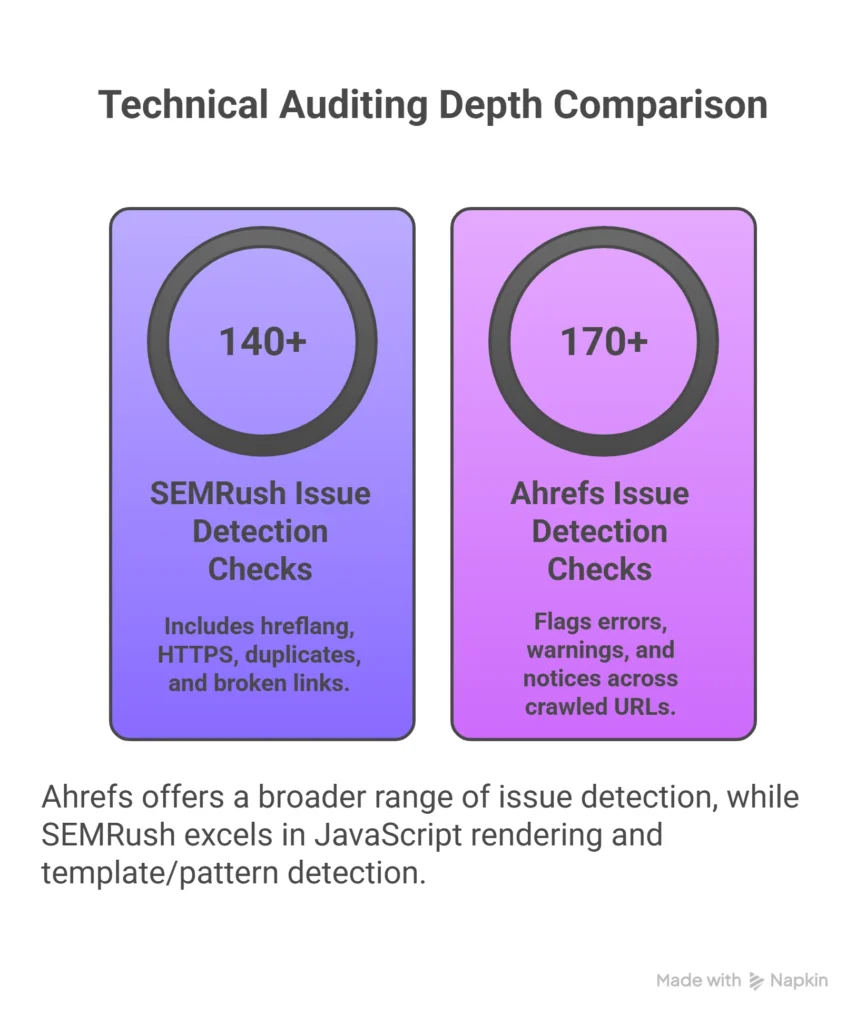
| Issue detection breadth | Runs 140+ checks, including hreflang, HTTPS, duplicates, and broken links technical issues. | Flags 170+ issues, grouped into errors, warnings, and notices across crawled URLs. |
| Template/pattern detection | Top Issues groups problems by priority and affected pages, supporting bulk template fixes. | Filters by folder depth and crawl depth, helping isolate repeated template problems. |
| Prioritization & actionability | Provides overall score and prioritized to-do list, separating errors and warnings fast visually. | Issues split into errors, warnings, notices; priorities adjustable, affecting Health Score directly. |
7) Backlink intelligence
| Pointer | SEMRush | Ahrefs |
| Link index size & freshness | Backlink database claims 43T links; interface refreshes every 15 minutes for changes. | Live backlinks index updates every 15–30 minutes; new link discovery varies by crawl. |
| Link quality signals | Uses Authority Score plus Backlink Audit Toxicity Score with many risk markers. | Uses Domain Rating, URL Rating, and Ahrefs Rank to gauge link strength. |
| Competitor link gap analysis | Backlink Gap compares domains, finds shared and unique referring domains to target. | Link Intersect highlights sites linking to competitors but not you, quickly today. |
| Link profile diagnostics | Shows anchors, follow attributes, lost and found domains, and toxicity breakdowns clearly. | Explains new and lost links with reasons, plus anchors and referring domains trends. |
| Reporting & exports | Exports link lists, builds scheduled reports, and supports disavow workflow files easily. | Exports backlink data, filters by attributes, and supports client-ready reports from Site Explorer. |
8) Competitive visibility (SOV)
| Pointer | SEMRush | Ahrefs |
| SOV definition | Position Tracking shows SOV weighting volumes and estimated traffic across tracked keywords. | Rank Tracker calculates SOV from estimated clicks versus total SERP clicks share. |
| Competitor discovery | Market Explorer maps market players; Position Tracking compares chosen rivals per campaign. | Rank Tracker Competitors report surfaces SOV trends versus selected competitor domains directly. |
| Market segmentation | Segment SOV by device, location, and tags inside Position Tracking dashboards easily. | Group keywords, locations, and devices; view SOV and SoTV by segments quickly. |
| Trend + change analysis | SOV charts show shifts over time; drill into keywords and SERP features. | Historical SOV charts track progress; competitor comparisons highlight gains and losses clearly. |
| Opportunity gaps | Use keyword gap tools to spot missed queries and prioritize high-impact visibility. | Use share-of-search and competitor reports to find gaps and grow SOV steadily. |
9) Monitoring & alerts
| Pointer | SEMRush | Ahrefs |
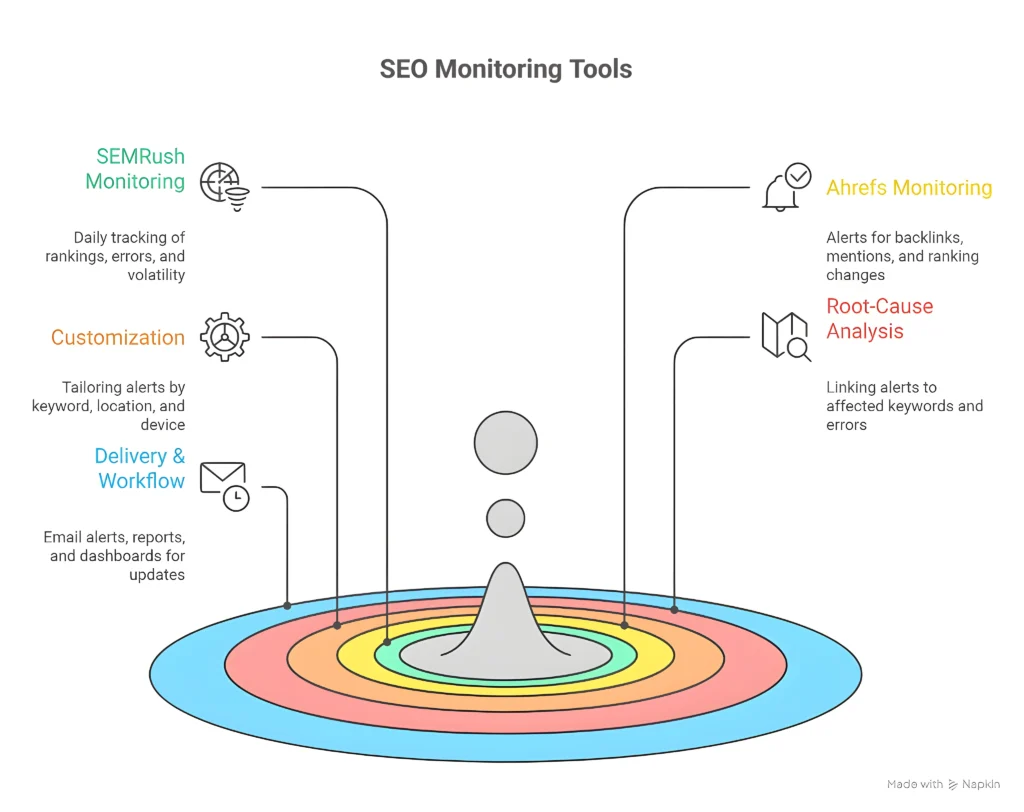
| What it monitors | Monitors rankings, Site Audit errors, and volatility signals through Sensor tracking daily. | Alerts track new and lost backlinks, web mentions, and keyword ranking changes. |
| Alert speed & reliability | Site Audit can run daily; Position Tracking triggers alerts when rankings shift. | Backlink and mention alerts update quickly; Always-on Audit emails critical issues promptly. |
| Customization | Custom triggers let you set thresholds by keyword groups, location, and devices. | Choose alert type and frequency for backlinks, keywords, mentions, Rank Tracker, Site Audit. |
| Root-cause context | Alerts link to affected keywords or new errors, with history inside dashboards. | Alerts show specific new links, mentions, or keywords, but deeper causes need analysis. |
| Delivery & workflow | Email alerts, scheduled PDF reports, and shareable dashboards support stakeholder updates easily. | Email alerts notify users; exports and reports support workflows across teams externally. |
10) Pricing & contract realities
Pricing changes often, so treat this as a buying checklist (plans, limits, add-ons).
| Pointer | SEMRush | Ahrefs |
| Pricing model drivers | Tiered plans (Semrush One + toolkits), priced by limits, seats, add-ons. | Tiered plans, priced by users, credits, projects, exports, tracked keywords. |
| Plan inclusions/exclusions | Higher tiers unlock historical data, bigger limits, and API on top tiers. | Enterprise adds API, SSO, audit logs, unlimited history, higher export limits. |
| Scaling cost | Extra users cost by tier; AI Visibility access priced separately per user. | Extra users cost by tier; higher plans increase limits substantially. |
| Contract terms | 7-day refund only for first annual order; month-to-month isn’t refundable. | Cancel anytime; ends at period finish; refunds generally not guaranteed. |
| Total cost to operate | Expect add-ons for seats, AI Visibility, and extra toolkits beyond core SEO. | Expect add-ons for users; Enterprise may be required for API/SSO needs. |
Pricing snapshots (official pages):
- SEMRush (SEO Toolkit): Pro $139.95/mo, Guru $249.95/mo, Business $499.95/mo. (SEMRush)
- SEMRush One: tiers include Starter, Pro+, Advanced; pricing starts around $165/mo billed annually, and Advanced shows $549/mo on the pricing page snippet. (investors.semrush.com)
- Ahrefs: Lite $129/mo, Standard $249/mo, Advanced $449/mo, Enterprise $1,499/mo (annual commitment required). (Ahrefs)
- User add-ons: SEMRush documents tier-based user pricing (+ AI Visibility per user), and Ahrefs lists per-user add-on costs by plan. (SEMRush)
- Refund/cancellation: SEMRush refunds are limited (7 days, first annual order); Ahrefs cancellation ends at the billing period, and refunds are discretionary. (SEMRush)
Conclusion
If you want one platform that goes beyond SEO, especially for competitor research, reporting, and broader marketing workflows, SEMRush is usually the better fit. If your priority is deep SEO research with a strong link and keyword-first workflow, Ahrefs often feels cleaner and faster.
Choose SEMRush if you:
- Need an all-in-one suite for SEO, competitive research, content, and marketing reporting.
- Want more built-in workflows for content planning, monitoring, and stakeholder-ready dashboards.
- Rely on structured projects and varied toolkits across teams, markets, and client accounts.
Choose Ahrefs if you:
- Care most about backlink intelligence, competitor research, and fast keyword-led content discovery.
- Prefer a simpler interface focused on core SEO tasks without extra marketing modules.
- Need strong research exports and an SEO workflow that stays lightweight and repeatable.
Trade-off: SEMRush can become expensive as seats and add-ons scale. Ahrefs can feel less “suite-like” for cross-channel marketing teams.
Frequently Asked Questions
How to conduct keyword research in Ahrefs?
Is Ahrefs worth it?
What’s better SEMRush or Ahrefs?
How to disavow links in Ahrefs?
What is Ahrefs Domain Rating?
What is SEMRush?
How accurate is SEMRush?