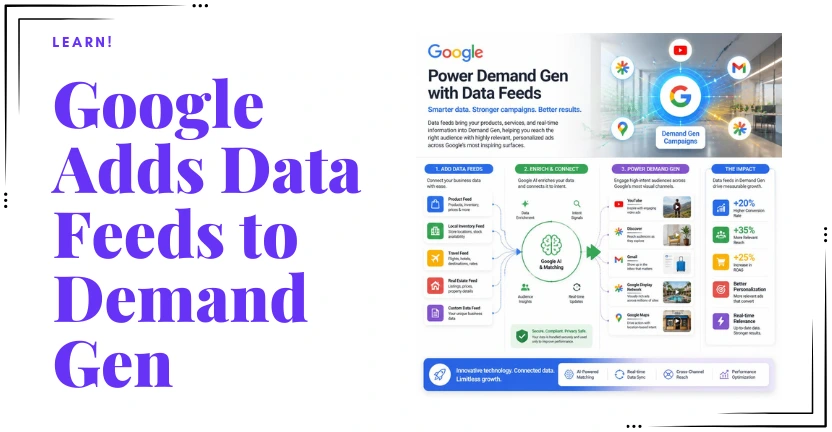
Google has introduced Demand Gen data feeds for businesses that need dynamic advertising but do not use Google Merchant Center. The update can help advertisers automatically display relevant inventory, services or offers using structured business information.
What exactly did Google launch?
Google is allowing advertisers to connect business data feeds to Demand Gen campaigns.
A business data feed is a structured file containing information about the items, services or inventory an advertiser wants to promote.
The feed might contain details such as:
- A destination
- A hotel
- A property
- A vehicle
- A service
- An image
- A price
- A landing-page URL
- Availability information
Google can use these details to create more relevant ads for different users.
The main advantage is that advertisers do not need to manually build and update every ad variation.
Google can match information from the feed with audience signals and available inventory.
Who can benefit from this?
The update is mainly designed for businesses that manage changing inventories but do not sell standard retail products through Merchant Center.
Google specifically identified industries such as:
- Travel
- Real estate
- Automotive
A travel company may use the feed to promote different destinations or hotel packages.
A real estate business may upload property listings.
An automotive company may use available vehicle information.
These advertisers often need dynamic creative, but their inventory does not fit neatly into a normal ecommerce product feed.
The new option reduces that gap.
Other inventory-driven or service businesses may also find the feature useful if their accounts are eligible and their data fits Google’s requirements.
How are these feeds different?
Google Merchant Center is built mainly for retail products.
A Merchant Center feed usually contains information such as:
- Product name
- Product image
- Price
- Availability
- Brand
- Product identifier
- Shopping landing page
Business data feeds are more flexible.
They allow advertisers to organise non-retail information that can still be used inside dynamic ads.
This does not mean Merchant Center is becoming unnecessary.
Retailers promoting physical products should still use Merchant Center because it supports Shopping ads, free listings and product-focused campaign features.
Business data feeds solve a different problem. They give non-retail advertisers a structured way to connect changing information with Demand Gen creative.
Where will the ads appear?
The biggest limitation is placement.
Business data feeds are currently supported only on the Google Display Network within Demand Gen campaigns. They are not yet supported across every Demand Gen surface.
Demand Gen campaigns can normally reach users across visual Google properties. However, advertisers should not assume that data-feed-driven creative will immediately appear across all available inventory.
This means the feature should be treated as a focused rollout.
Advertisers need to check:
- Which placements are eligible
- How much spend goes to those placements
- Whether feed-based ads outperform standard assets
- Whether the generated combinations represent the brand correctly
- Whether landing pages match the promoted item
The feature may expand later, but Google has not confirmed a wider timeline.
Why should advertisers care?
Dynamic ads can reduce repetitive campaign work.
Without a feed, an advertiser may need to create separate assets for every hotel, car, property or service.
That process can become difficult when inventory changes regularly.
A feed allows the business to update the source information instead of manually editing many ads.
This can create several benefits.
Faster updates
When availability or inventory changes, the business can update the feed.
That is easier than replacing several individual advertisements.
Better relevance
Google can select information that appears more relevant to a user.
A person interested in a particular destination may see a related travel offer instead of a general brand advertisement.
More scalable creative
Advertisers can promote a wider set of items without building every combination manually.
Lower dependence on Merchant Center
Businesses outside traditional retail no longer need to force their inventory into a product-feed system that was not designed for them.
More useful automation
Structured data gives Google’s system clearer information than a collection of general images and headlines.
However, automation does not guarantee better performance.
The quality of the result depends heavily on the quality of the feed, images, landing pages, audience signals and conversion tracking.
What could go wrong?
Feed-based advertising introduces operational risks.
Incorrect information
An outdated price or unavailable item can create a poor user experience.
The ad may attract a click, but the landing page may not match what the user expected.
Weak images
Dynamic systems can only work with the assets they receive.
Low-quality or inconsistent images can make ads look unprofessional.
Poor feed structure
Missing fields, inconsistent labels or incorrect URLs may reduce the number of usable items.
Limited creative control
Automation may choose combinations that are technically correct but do not reflect the advertiser’s preferred message.
Tracking problems
More relevant ads are useful only if conversion measurement is accurate.
Poor tracking can cause Google to optimise toward weak or misleading signals.
Advertisers should not simply upload a feed and assume the system will manage everything correctly.
Human review remains necessary.
What is the wider context?
Google has been adding more automation to Demand Gen campaigns.
Demand Gen is designed to help advertisers create demand with visual ads rather than only responding to direct search queries.
Earlier dynamic capabilities were more closely connected to ecommerce and retail inventory.
The addition of business data feeds expands the system to industries with structured but non-retail inventory. Search Engine Land described this as a move to make Demand Gen more useful beyond ecommerce.
It also reflects a wider advertising trend.
Platforms are asking businesses to provide better first-party data, structured content and conversion signals. The platform then uses AI to select audiences, placements and creative combinations.
This can improve scale, but it also changes the advertiser’s role.
The work moves away from building every individual ad and toward:
- Maintaining data quality
- Defining strong offers
- Supplying good assets
- Setting clear conversion goals
- Reviewing automated results
- Protecting brand accuracy
The feed becomes an important part of campaign quality.
What should marketers do next?
Advertisers in eligible industries should begin with a controlled test.
Review your inventory structure
Decide which information changes regularly and would benefit from automation.
Examples include:
- Vehicle availability
- Property listings
- Travel packages
- Hotel rooms
- Service locations
- Event availability
Clean the source data
Check that every feed item contains accurate:
- Names
- Descriptions
- Images
- Prices
- Availability
- Landing pages
Remove duplicate and expired entries.
Create matching landing pages
Every promoted item should lead to a relevant page.
Do not send all dynamic ads to a general homepage.
Confirm conversion tracking
Review whether leads, bookings or sales are being measured correctly.
The campaign should optimise for meaningful outcomes, not only clicks.
Compare against a control
Run feed-based ads alongside the current approach.
Compare:
- Cost per lead
- Conversion rate
- Click-through rate
- Qualified lead volume
- Revenue or booking value
- Creative quality
- Time saved
Review generated ads
Check the actual combinations Google serves.
Watch for incorrect claims, mismatched images or outdated information.
What happens next?
The most important thing to monitor is whether Google expands business data feeds beyond the Display Network.
Support across more Demand Gen surfaces could make the feature much more valuable.
Advertisers should also watch for:
- Additional supported industries
- Improved feed templates
- Better reporting
- More creative controls
- Wider placement support
- Integration with other Google campaign types
For now, this is a useful test for businesses with large or frequently changing inventories.
The real opportunity is not simply automated ad creation. It is the ability to connect clean business data with more relevant advertising at scale.