A newly published nine-month study gives marketers a rare look at AI Overview traffic after the click. The analysis tracked 51,200 events across 1,661 cited snippets for one transportation brand and found a meaningful gap between what appeared to come from Google’s AI results and how GA4 classified some of those visits.
What did the study find?
Search Engine Land published the research by Alex Galinos on August 18, 2026.
The dataset covered September 2025 through June 2026.
It included 51,200 tracked events associated with 1,661 cited snippets.
The biggest measurement finding was attribution.
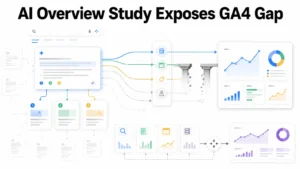
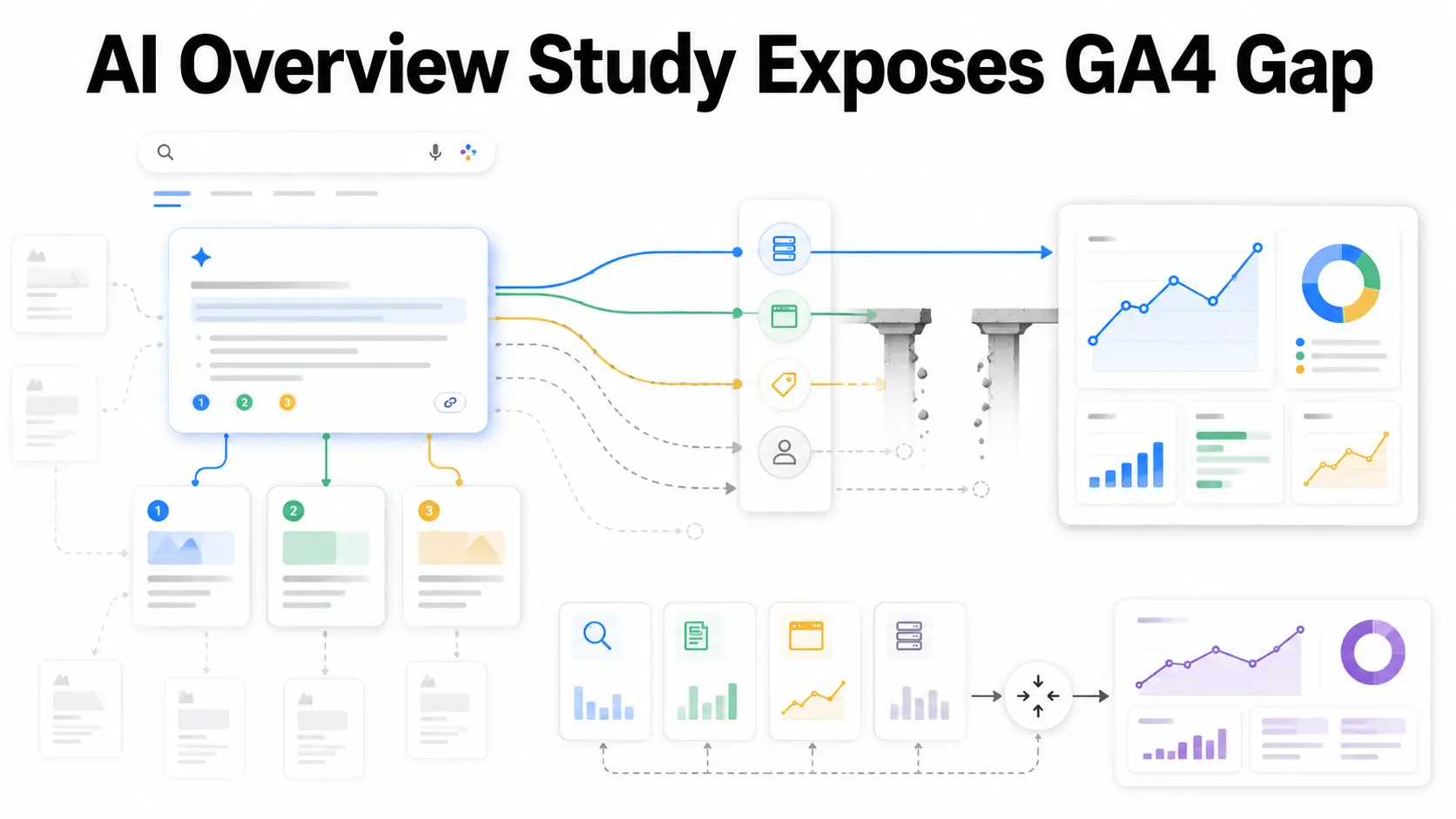
The study found that 22.4% of tracked events were classified as Direct rather than Organic Search in GA4.
That represented 11,468 events in the dataset.
The monthly rate was not stable. It ranged from 16.8% to 29.3%.
This does not mean 22.4% of every website’s AI Overview visits are misclassified.
It is:
- One brand
- One implementation
- One tracking method
That distinction is essential.
How was the traffic identified?
The project used URL text fragments that can appear after the hash symbol, such as:
#:~:text=
These fragments can direct a browser to specific text on a destination page.
The team created a custom GA4 dimension to capture visits containing the pattern and used it as a proxy for AI Overview citation traffic.
This is useful because normal analytics reporting does not provide a simple dedicated AI Overview acquisition channel.
But the method has limitations.
Text fragments can also appear from other Google Search features, including Featured Snippets and People Also Ask.
The researcher has publicly acknowledged this limitation.
That means the dataset is useful for understanding behaviour.
It is not a perfect official AI Overview measurement system.
Why does GA4 attribution matter?
Google says websites appearing inside AI Overviews and AI Mode are included in overall Search Console traffic.
They appear within the Web search type in the Performance report.
From an SEO reporting perspective, that activity belongs inside Google Search performance.
But once somebody reaches the website, analytics attribution can behave differently.
If expected referral information is not preserved, GA4 may classify the activity differently.
The study found a meaningful portion inside Direct.
That creates a reporting gap.
An SEO team might see Search Console activity rising while GA4 organic sessions appear weaker than expected, which can distort budget decisions and forecasting.
How large was AI Overview traffic?
The same study estimated that AI Overview-related activity represented 7.53% of the brand’s organic sessions over the full study period.
The share moved sharply over time.
It reached roughly:
- 16% to 17% in February and March
- Around 2% to 4% in more recent months
That volatility means marketers should not turn one month of AI Overview referral activity into a permanent forecast.
Exposure can change with:
- Query mix
- Citation selection
- Google’s systems
- Search behaviour
AI traffic needs trend reporting, not one-off snapshots.
Was traffic evenly distributed?
No.
The study showed strong concentration.
The most productive cited snippet generated 2,276 tracked events, while the average across all 1,661 snippets was only 31 events.
Counting citations alone can therefore be misleading.
Ten citations that never generate meaningful visits may be less valuable than one citation attached to an important customer journey.
Connect citation tracking with traffic and business outcomes whenever possible.
What content appeared frequently?
On this particular website, structured HTML comparison tables appeared disproportionately often among cited content.
That is interesting.
It should not become a new SEO rule such as:
Add tables and Google will cite you.
The research shows correlation inside one dataset.
It does not prove that tables caused the citations.
A more useful lesson is that clear, structured information can be easier to understand and reuse.
Useful formats can include:
- Comparison tables
- Short definitions
- Direct answers
- Step-by-step instructions
- Clearly labelled specifications
Use the format because it helps the user understand the information.
Not because it is supposed to be an AI ranking shortcut.
What are the study’s limits?
There are three important caveats.
First, it covers one transportation brand.
Results may look very different for:
- Ecommerce
- Publishing
- Finance
- Healthcare
- Local businesses
Second, the text-fragment method can capture activity from other Google features.
It does not provide perfect AI Overview isolation.
Third, one reported share compares event-scoped tracking with session-level organic data.
The researcher explicitly notes this mismatch.
That makes the percentage useful directionally, but not suitable as a universal industry benchmark.
These limitations do not make the research unhelpful.
They explain how carefully marketers should interpret it.
Why should SEO teams care?
The study exposes a wider measurement problem.
AI search visibility is moving faster than the reporting systems marketers use to explain it.
Teams increasingly need to combine several sources:
- Search Console
- GA4
- Citation tracking
- First-party analytics
- Server logs
No single source tells the whole story.
Search Console includes AI features inside Web reporting, while GA4 shows what visitors do after arrival.
The study suggests some visits may not land inside the expected organic bucket.
Google itself recommends using Search Console and Analytics together because they answer different parts of the customer journey.
What should marketers measure?
Start by building your own baseline rather than copying the 22.4% figure.
Track:
- Landing pages cited in AI Overviews
- Search Console clicks and impressions
- GA4 Organic Search trends
- GA4 Direct trends
- Referral and text-fragment patterns
- Conversions from likely AI landing pages
- Revenue or leads
If Direct traffic rises on pages that are simultaneously gaining AI Overview exposure, investigate before assuming that traffic is truly “direct.”
Also compare page groups.
A measurement issue may be easier to identify on content heavily exposed to AI Overviews than across the entire website.
What happens next?
Google may eventually provide different AI reporting, but marketers should not build strategies around an unannounced product change.
For now, the practical approach is triangulation.
Use Search Console to understand Google Search visibility.
Use GA4 to understand user behaviour after arrival.
Add custom tracking when:
- The method is documented
- The limitations are understood
- The data can be validated
Most importantly, stop treating citation count as the final KPI.
A stronger question is:
Did the citation create useful visibility, a qualified visit or a measurable business outcome?
The August 18 study shows why that question is harder to answer than it looks.
It also gives marketers a better framework for building AI-search measurement that acknowledges uncertainty instead of hiding it.