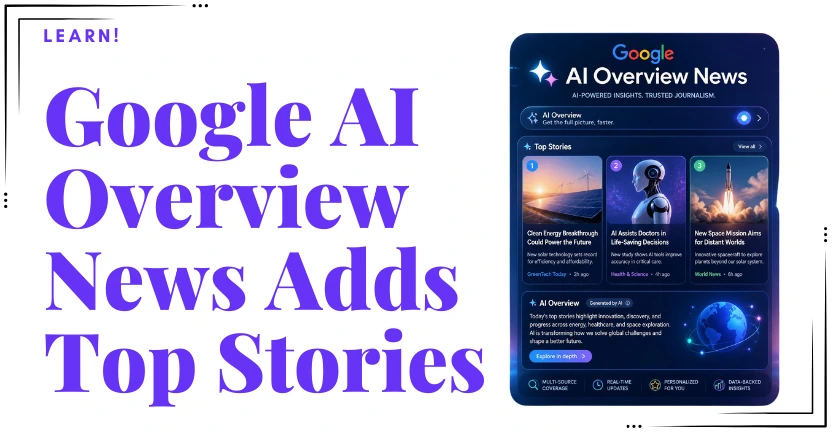
Google has added a Top Stories-style news carousel to AI Overviews for some developing searches. The feature gives timely articles a more visible place inside Google’s AI-generated answers and could create a new traffic opportunity for publishers.
What exactly did Google change?
Google has started showing current news articles and Top Stories within AI Overviews.
The feature is designed for searches about developing topics. These may include breaking news, ongoing events or subjects where new information is being published regularly.
A Google spokesperson confirmed that the feature is fully live for mobile users in the United States on supported queries. It is not yet available for every search or every user.
The feature can display a prominent carousel containing articles from different publishers. Google may also highlight publications that a user has selected through its Preferred Sources feature.
This is an important difference from the normal AI Overview format.
A standard AI Overview usually summarises information from several sources. Links may appear within or beside the generated answer. The new format gives fresh articles a more visible and familiar news-style placement.
Instead of being included only as a small citation, a publisher may appear as an article card inside a carousel.
Where is the feature available?
The rollout remains limited.
The key details currently confirmed are:
- It is live in the United States.
- It is available on mobile devices.
- It appears only for some searches.
- It focuses on developing topics.
- It can display recent articles prominently.
- It may include a user’s Preferred Sources.
Google has not confirmed when the feature will expand to desktop users or additional countries.
It has also not explained exactly how it decides which stories qualify for the carousel.
Publishers should therefore avoid treating this as a guaranteed traffic source. The feature represents a new opportunity, but visibility will still depend on Google’s systems and the nature of the search.
Why should publishers care?
AI-generated answers have created a difficult situation for many publishers.
A user can often get the main answer without opening a website. This can reduce clicks, especially for simple informational searches.
News content is different because freshness matters.
A generated summary can quickly become outdated when a story is still developing. Google needs access to new reporting, updated facts and different perspectives to keep the answer useful.
The Top Stories carousel gives Google a way to surface that fresh information while also sending users to publishers.
This may help publishers in several ways:
- Fresh articles can receive a prominent position.
- Smaller publishers may gain visibility for specific stories.
- Preferred Sources may strengthen direct audience relationships.
- Updated reporting may continue earning visibility as a story develops.
- Strong headlines may attract clicks from inside the AI answer.
However, appearing in the carousel will likely be competitive.
Several publishers may be covering the same event. Google has limited space available, which means timeliness alone may not be enough.
Publishers may also need clear reporting, strong authority, accurate headlines and useful updates.
How could this change news SEO?
Traditional news SEO focuses on factors such as speed, crawlability, headlines, authority and article freshness.
Those fundamentals still matter.
However, AI-generated answers add another layer. Google needs to understand not only that an article is recent, but also what new information it contributes.
Publishing the same basic facts as every other website may not be enough.
An article is more useful when it adds:
- A confirmed new detail
- Original reporting
- A direct statement
- A clear timeline
- Expert analysis
- Updated figures
- Local or industry context
- A meaningful explanation of what changed
Publishers should make the new information easy to find.
The article should not hide the latest development below several paragraphs of background. The opening should immediately explain what is new.
Clear headings can also help Google understand the article’s structure.
Examples include:
- What was announced?
- Who is affected?
- When will it launch?
- What changed today?
- What happens next?
This type of structure is useful for readers and easier for search systems to process.
How does Preferred Sources fit in?
Google previously introduced Preferred Sources to let users select publications they want to see more often.
When those publishers cover a relevant story, Google may highlight them in Top Stories or related search experiences.
The new AI Overview carousel can also highlight Preferred Sources, according to Google’s earlier explanation of the feature.
This makes direct audience trust more valuable.
A publisher that builds a recognisable brand may have an advantage over a website that depends only on ranking for individual keywords.
Publishers can encourage loyal readers to:
- Follow the brand
- Subscribe to newsletters
- Return directly
- Select the publication as a preferred source
- Engage with its reporting on other platforms
This does not replace SEO. It creates another signal that may influence how often a publication appears for an individual user.
What is the wider context?
Google first discussed more visible fresh links inside AI Overviews in May 2026.
The company said users searching for developing topics would begin seeing fresh perspectives, new updates and more prominent links. The July rollout confirms that the feature is now live for some U.S. mobile searches.
The update also comes during an ongoing debate about how AI search affects website traffic.
Google says its AI search features are sending billions of clicks to websites each week. However, the company has not released enough detailed data for publishers to independently assess that claim by query type, industry or AI feature.
That distinction matters.
A large total number of clicks does not automatically mean every publisher is receiving more traffic. Traffic may be distributed unevenly across websites, topics and search formats.
The Top Stories rollout is therefore meaningful because it gives publishers a clear, visible linking format rather than relying only on citations inside generated text.
What should publishers do now?
Publishers should not rebuild their complete strategy around one limited rollout.
They should improve the systems that already support strong news visibility.
Publish the main fact quickly
The first version of the article should clearly explain the confirmed development.
Do not delay useful information with a long introduction.
Update the same page carefully
When a story develops, add meaningful updates and clearly note what changed.
Avoid making small edits only to create an artificial freshness signal.
Strengthen headline quality
The headline should explain the new development accurately.
Avoid vague wording and unnecessary clickbait.
Use clear timestamps
Show when the article was published and when it was last updated.
This helps readers understand how current the information is.
Add original value
Include direct reporting, useful context, verified quotes or practical analysis.
Articles that merely repeat the same announcement may struggle to stand out.
Monitor traffic separately
Track whether traffic arrives from:
- Google Discover
- Google News
- Traditional search
- AI Overviews
- Other referral sources
Google still provides limited reporting for AI search. Publishers may need to use landing-page patterns, referral data and manual testing to understand performance.
What happens next?
Google is expected to expand the format to more users over time, but no wider rollout date has been confirmed.
Publishers should monitor:
- Desktop availability
- Expansion outside the United States
- Search Console reporting changes
- Which topics trigger the carousel
- How Preferred Sources affect visibility
- Whether the feature produces meaningful clicks
The main lesson is simple: AI answers still need current and trustworthy information.
Publishers that report quickly, add something new and make their content easy to understand may have a stronger chance of appearing during the news moment.