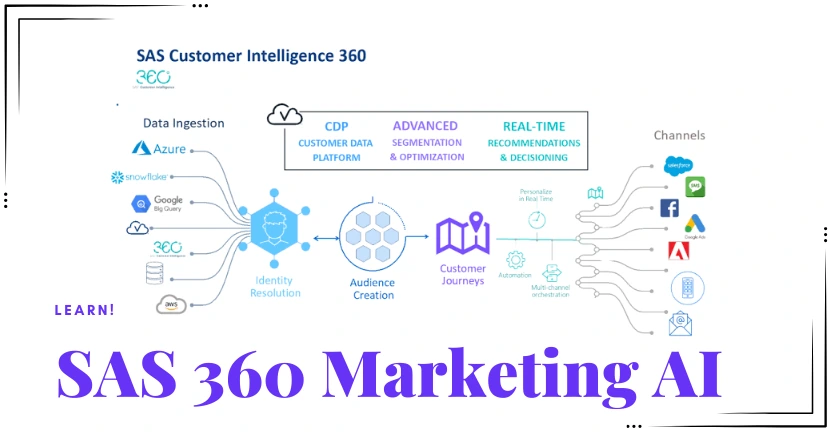
SAS 360 Marketing AI is a new solution designed to help marketing teams build, deploy and monitor predictive machine-learning models through guided workflows. SAS announced the product on July 8, 2026, as a way to help marketers act on customer data without depending entirely on overstretched data-science teams.
What did SAS announce?
SAS introduced a marketer-friendly modelling and scoring system for common customer analytics tasks.
The platform combines:
- Guided project workflows
- Customizable recipe templates
- Automated data preparation
- Machine-learning model training
- Customer-level scoring
- Model monitoring
- Governance controls
The aim is to help marketers move from identifying a customer opportunity to using that insight inside a campaign or customer journey.
SAS says the platform can work as a standalone modelling and scoring engine. It can also connect with the wider SAS Customer Intelligence 360 ecosystem for journey orchestration, personalization and marketing decision-making.
This connection matters.
Many companies can already analyse customer behaviour. The harder part is turning that analysis into a decision that changes what a customer sees, receives or experiences.
How does the platform work?
The platform uses guided projects and prebuilt templates to make model development easier for marketers and analysts.
A user can begin with a business problem instead of starting with code or a blank modelling environment.
The workflow may include:
- Selecting the relevant customer group
- Defining the target outcome
- Preparing customer data
- Creating useful variables
- Training and comparing models
- Reviewing model accuracy
- Generating customer scores
- Activating those scores
- Monitoring model performance
SAS says its generative AI and copilot features can explain model results, feature importance and recommended actions in natural language. This may help marketers understand why a model produces a particular result.
However, the tool is not positioned as a complete replacement for data scientists.
SAS says marketers can use simplified workflows, while data scientists retain access to advanced modelling and governance controls. The platform is designed to improve collaboration between marketing, analytics and data-science teams.
Which models can marketers build?
SAS highlights several common marketing use cases.
These include:
- Conversion propensity
- Customer acquisition
- Churn prediction
- Next-best action
- Next-best offer
- Cross-selling
- Customer lifetime value
- Customer segmentation
A conversion propensity model estimates how likely a customer is to complete an action, such as making a purchase or responding to an offer.
A churn model estimates which customers may cancel, leave or stop buying.
A customer lifetime value model estimates the possible long-term value of a customer relationship.
A next-best-action model helps select the most suitable message, offer or intervention for a customer.
The model itself is only one part of the process.
The real value comes when the score leads to a practical action.
For example:
- A high churn score could trigger a retention journey.
- A strong conversion score could increase campaign priority.
- A cross-sell score could change the product recommendation.
- A lifetime-value score could influence service or retention investment.
SAS says model outputs can be activated inside its own customer engagement tools or exported to third-party marketing technology platforms.
Why should marketers care?
Marketing teams often have access to large amounts of customer data but limited ability to turn it into predictive action.
A traditional modelling request may involve several stages:
- Marketing defines the business question.
- An analytics team collects and prepares the data.
- A data scientist builds the model.
- Stakeholders review the results.
- Another team deploys the scores.
- Marketing finally uses them in a campaign.
This process can take weeks or months.
SAS says data preparation can account for up to 80% of model-development effort. Its new platform is designed to automate parts of data preparation, feature engineering, model training and deployment.
The bigger shift is that marketing AI is moving beyond content generation.
Generative AI helps teams create:
- Copy
- Images
- Summaries
- Campaign ideas
- Content variations
Predictive AI helps teams decide:
- Which customer may convert
- Which customer may leave
- Which offer may be relevant
- Which audience needs attention
- When an intervention may be useful
This can make customer journeys more relevant.
But it can also scale weak decisions when the data, model or business rules are poor.
What does governance add?
Giving marketers easier access to machine learning creates both opportunity and risk.
A model can appear accurate while still producing an unfair or ineffective business outcome.
For example:
- A churn model may perform differently across customer groups.
- A conversion model may target people who would have purchased anyway.
- A lifetime-value model may reinforce historical bias.
- A next-best-offer model may prioritise short-term revenue over customer trust.
SAS says the platform includes:
- Explainability
- Visibility into model inputs and outcomes
- Bias detection and mitigation
- Model-performance monitoring
- Automated retraining
- Governance across the model lifecycle
These controls are important because models can become less accurate over time.
Customer behaviour changes. Prices change. Products change. Market conditions change. A model trained on older behaviour may no longer reflect current reality.
Monitoring should therefore check more than technical accuracy.
Teams should also review:
- Conversion impact
- Incremental revenue
- Retention
- Customer complaints
- Offer relevance
- Performance across customer groups
What are the main limits?
The announcement explains the product’s intended capabilities, but several commercial details are not publicly clear.
The official pages do not provide:
- Standard public pricing
- Independent performance benchmarks
- Guaranteed implementation timelines
- Complete account eligibility requirements
- Evidence that every use case can run without specialist support
The performance and return-on-investment claims come from SAS, the product provider. Marketing teams should test those claims against their own data and existing processes.
The tool should be treated as a collaboration layer, not as a replacement for:
- Data science
- Privacy review
- Legal review
- Business judgement
- Human campaign oversight
Teams must still confirm whether their customer data is complete, accurate and legally usable for the intended purpose.
How should teams test it?
The safest approach is to begin with one measurable use case.
Churn prevention, conversion scoring or campaign-response prediction can work well because the outcome can be clearly defined and compared.
1. Choose one business outcome
Select a measurable result such as lower churn, higher conversion or improved customer retention.
2. Audit the data
Check for:
- Missing information
- Duplicate customer records
- Inconsistent definitions
- Consent restrictions
- Historical bias
- Outdated variables
3. Create a baseline
Compare the predictive model with the segmentation or business rules already in use.
Without a baseline, teams cannot prove that the new model is better.
4. Review the explanation
Understand which variables influence the score.
A model should not be activated simply because it produces a high accuracy number.
5. Test a limited audience
Run the model on a controlled customer group before using it across the complete database.
6. Measure business impact
Track:
- Incremental conversions
- Retention
- Revenue
- Campaign cost
- Customer experience
- Complaints
- Model accuracy
7. Monitor bias and drift
Review whether performance differs across customer groups or declines as behaviour changes.
What happens next?
SAS 360 Marketing AI reflects a wider change in marketing technology.
AI is moving from helping marketers create content to helping them make customer-level decisions.
That can improve speed and personalization, but it also gives marketing teams greater responsibility.
A predictive score is not a guaranteed answer. It is an estimate based on past data, selected variables and model assumptions.
The strongest implementation will combine:
- Marketing knowledge
- Data-science discipline
- Human review
- Governance
- Continuous measurement
Teams should begin with one useful problem, prove that the model creates incremental value and review accuracy and fairness before expanding automation across the customer journey.