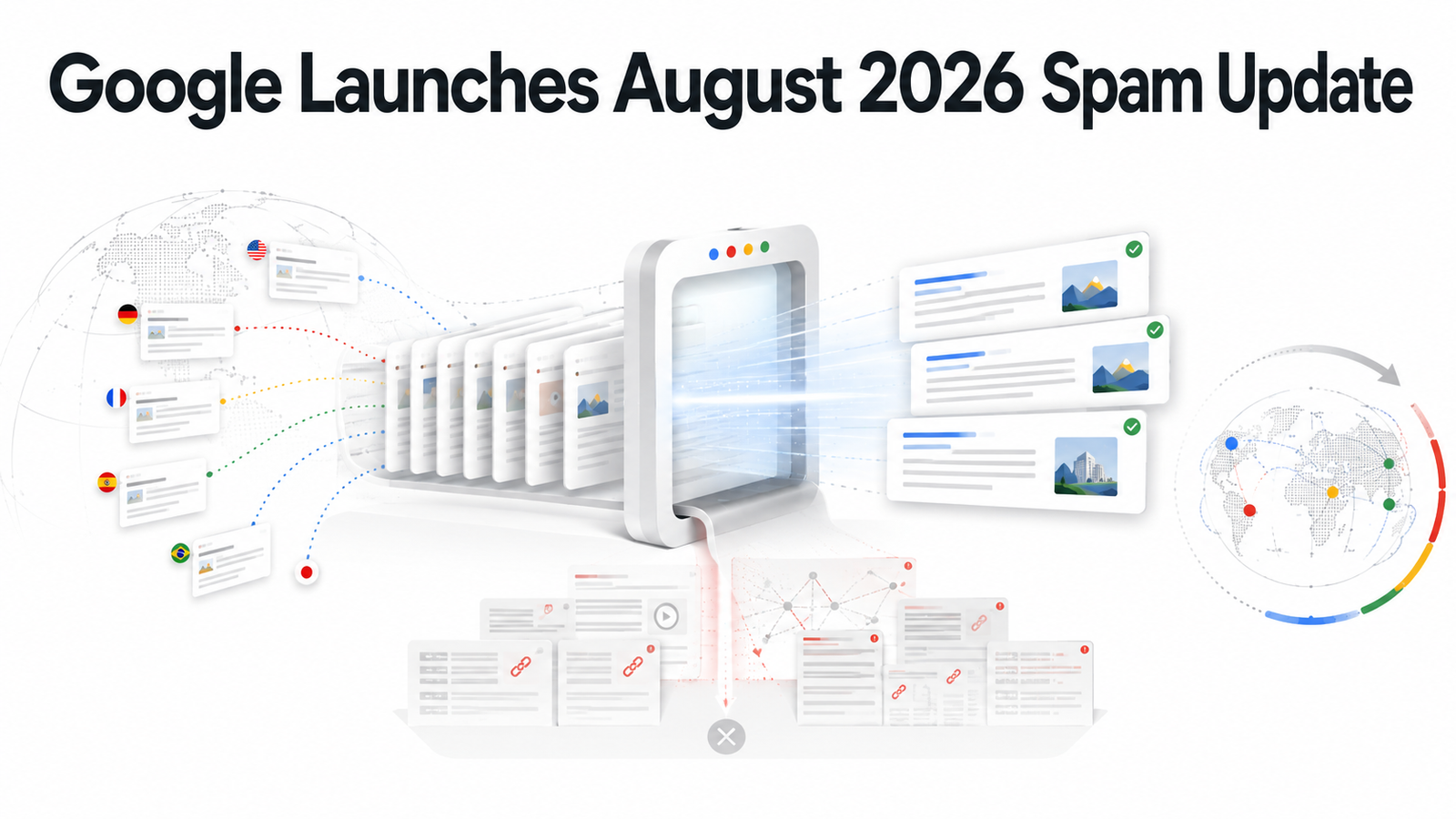
Google started rolling out the August 2026 Google spam update on August 18. The update applies globally and to all languages, and Google said the rollout may take a few days. For SEO teams, the important point is not to guess which tactic Google targeted. Google has not shared that level of detail.
What did Google release?
Google recorded the update on the Search Status Dashboard at 9:28 a.m. Pacific Time on August 18. That was still August 18 in India, placing the announcement inside the Asia/Kolkata research window.
Google described it as the August 2026 spam update. It affects ranking and applies worldwide across all languages.
The company did not announce a specific:
- Country
- Industry
- Device type
- Spam category
Google also said the rollout may take a few days. Rankings may therefore continue moving while the systems are being updated.
What does the rollout cover?
Google spam updates improve automated systems used to detect behaviour that violates Search spam policies.
Google says these systems operate continuously. A named spam update means the company has made a notable improvement to how those systems work.
SpamBrain is one example. Google describes SpamBrain as its AI-based spam-prevention system, but it has not said that this particular update is limited to SpamBrain.
That distinction matters.
Marketers should not turn a broad spam update into an invented list of “confirmed targets.”
What Google has confirmed is simple:
- The update started August 18.
- It is global.
- It covers all languages.
- It may take several days to finish.
Everything more specific needs evidence.
Why does this matter for SEO?
Spam updates can change which pages deserve to remain visible in Search.
A site that benefited from manipulative practices may lose rankings, impressions and clicks when Google becomes better at detecting those practices.
A compliant site can also move because competing pages are being reassessed.
That is why an SEO team should look beyond one keyword.
Monitor changes across:
- Organic clicks and impressions
- Landing-page groups
- Query categories
- Countries and devices
- Competitor visibility
- Indexed pages
- Conversion and revenue trends
Google recommends using Search Console performance data to understand changes by queries, pages and countries rather than relying on a single ranking observation.
What does Google call spam?
Google defines Search spam as techniques used to deceive users or manipulate Search systems into giving content more visibility.
Its policies cover practices such as:
- Cloaking
- Hidden text
- Keyword stuffing
- Sneaky redirects
- User-generated spam
- Other manipulative practices
Google’s current wording also includes attempts to manipulate generative AI responses within Google Search.
That does not mean AI-generated content is automatically spam.
The issue is whether content and tactics are being used to manipulate Search.
Teams should review Google’s actual policy language instead of reacting to claims that “AI content was hit.”
How should you read ranking changes?
Do not diagnose the update from one day of data.
A multi-day rollout can create volatility before results settle.
Seasonality, tracking changes, demand shifts, website releases and competitor activity can also move organic performance at the same time.
Start with a clean comparison.
Look at the period before the update. Then monitor the rollout and several days after Google confirms completion.
Segment:
- Branded and non-branded queries
- Product pages
- Category pages
- Articles
- Location pages
Then ask whether the decline is concentrated.
If only one content type falls, audit that template.
If the entire domain moves, investigate broader site patterns.
The goal is diagnosis, not panic.
What should affected sites do?
Google’s advice is direct: review its spam policies and make sure the website complies.
That means auditing practices rather than chasing a quick technical trick.
Check for issues such as:
- Scaled low-value pages
- Hidden or misleading content
- Suspicious redirects
- Manipulative links
- Hacked or injected pages
- Thin third-party sections
- Uncontrolled user-generated spam
Also inspect Search Console for security issues and manual actions.
A spam update itself is based on automated systems, so an affected site does not necessarily need to have received a manual action. Google separately uses both automated spam systems and human reviews.
What should you avoid doing?
Avoid deleting large sections of a website simply because rankings moved for two days.
Do not buy new links to “replace authority.”
Do not rewrite hundreds of pages around a guessed ranking factor.
And do not copy whatever a competitor is doing simply because it rose during the rollout.
Google says recovery after spam-related changes can take time. Its automated systems may need months to determine that a site is complying again.
That makes frantic short-term changes especially risky.
Fix clear policy problems first.
Improve weak pages because they are weak, not because somebody claims to know the secret target.
What happened earlier in 2026?
This is Google’s third named spam update of 2026.
The Search Status Dashboard lists:
- March 2026 spam update
- June 2026 spam update
- August 2026 spam update
Google also ran core updates in March and May.
Earlier rollout lengths do not predict this one. Google has only said the August update may take a few days.
The history does show that spam enforcement has remained an active part of Google’s ranking work during 2026.
What should teams monitor now?
Create an annotation in your SEO reporting system for August 18, 2026.
Then review performance daily without making daily strategy changes.
Watch:
- GSC clicks and impressions by page type
- Average position as supporting context
- Non-brand query visibility
- Organic sessions and conversions
- Major competitor movements
- Indexing or technical anomalies
If a meaningful decline begins during the rollout, document it.
Once Google confirms completion, compare winners and losers and look for common patterns.
Third-party visibility tools can help identify market-wide movement, but Search Console and analytics should remain the primary sources for your own website.
What happens next?
The first step is to wait for Google to confirm that the rollout has finished.
After that, teams with meaningful losses should run a policy-led audit.
Review:
- Pages that lost the most visibility.
- Queries they previously ranked for.
- How those pages were produced.
- How they were promoted or linked.
- Whether any practice conflicts with Google’s spam policies.
Sites that remain stable should still check for hidden risk, especially hacked content, low-quality scaled pages and poorly controlled user-generated sections.
The August update matters.
But Google has not announced a new SEO trick.
The practical response remains the same: follow Search policies, create genuinely useful pages, remove manipulative practices and measure changes with enough data to separate a real update impact from normal noise.
Sources
- Google Search Status Dashboard, August 2026 spam update, August 18, 2026.
- Google Search Central, Google Search spam updates and your site.
- Google Search Central, Spam policies for Google web search.
- Search Engine Land, Google releases August 2026 spam update, August 18, 2026.