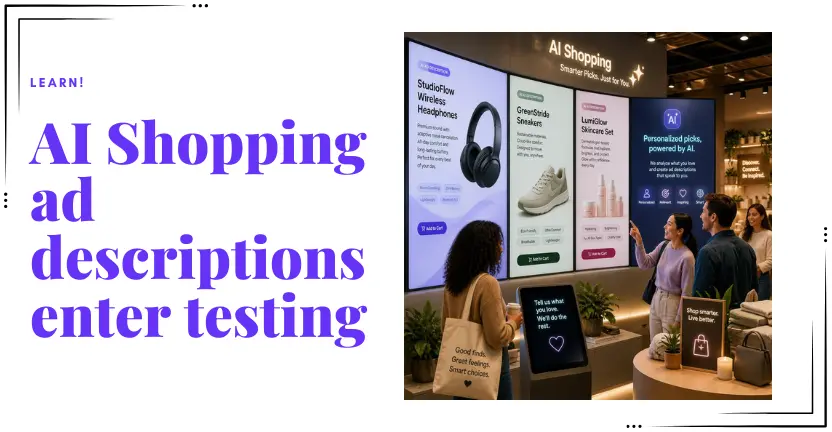
Google is testing AI Shopping ad descriptions that can explain product benefits using information from a retailer’s website and product data. The test extends Google’s wider use of generated advertising copy into Shopping placements.
AI Shopping ad descriptions
What did Google start testing?
Advertisers have started seeing Shopping ads with descriptions created by Google’s AI systems.
A standard Shopping ad usually relies heavily on information from a Merchant Center feed, such as:
- Product title
- Image
- Price
- Brand
- Seller name
- Promotions
- Availability
The new test can add generated descriptive text that explains product features or benefits.
Search Engine Land reported that Google confirmed the test and said it uses information from both the product feed and the retailer’s website.
This means the final advertising message may not come directly from one field written by the advertiser.
Google may combine several sources to create a description it believes matches the shopper’s intent.
Where is the test appearing?
The descriptions have been observed in Google Shopping ads.
Google has not published complete public details about:
- Every eligible country
- Every Shopping campaign type
- The number of advertisers included
- Whether advertisers can opt out
- How descriptions are approved
- Which queries trigger them
- How often they appear
The feature should therefore be treated as a test, not as a full global rollout.
Google previously confirmed a similar experiment involving generated descriptions in Search advertising. The Shopping test extends that direction into ecommerce ads.
How might Google create the copy?
Google says its systems can use information from the Merchant Center feed and the advertiser’s website.
That information may include:
- Product attributes
- Product descriptions
- Materials
- Sizes
- Use cases
- Benefits
- Landing-page text
- Category information
Google’s AI Max for Shopping documentation already describes a system that uses Merchant Center details such as material, durability and fit to understand product context.
For example, a feed may identify a product as:
Women’s walking shoe, blue, size 8
The website may add that the shoe has:
- Lightweight cushioning
- A flexible sole
- Water-resistant material
- Wide-fit sizing
Google could use this wider information to create a more useful description.
The possible benefit is stronger relevance.
The risk is that the generated copy may not match the advertiser’s approved wording.
Why should ecommerce teams care?
Shopping ads have traditionally been highly dependent on structured product data.
Retailers improve performance by optimizing:
- Product titles
- Descriptions
- Images
- Product categories
- Pricing
- Availability
- Identifiers
Generated descriptions add another layer.
Google may decide which feature to highlight based on the query.
For one shopper, it may mention price.
For another, it may mention durability, fit or suitability for a specific activity.
This could help advertisers match more detailed shopping searches.
A user may search:
Lightweight office shoes for standing all day
The product title may not contain that complete phrase.
However, Google may find relevant supporting information on the page and use it in the ad description.
That could improve:
- Ad relevance
- Click-through rate
- Product discovery
- Query coverage
- Conversion potential
It may also make performance harder to explain because the advertiser does not write every message manually.
What are the main risks?
Incorrect product claims
Google may generate a benefit that is not fully supported.
For example, it could describe a product as waterproof when the page only says water-resistant.
Outdated website information
The feed may be current while the landing page contains an old feature, price or promotion.
Brand-language problems
Generated text may be technically accurate but inconsistent with the retailer’s tone.
Legal and compliance issues
Products in finance, health, beauty or regulated categories may require approved claims and disclaimers.
Weak landing-page alignment
The description may highlight a feature that is difficult to find after the user clicks.
Limited reporting
Advertisers may not receive enough detail about which generated descriptions appeared and how each version performed.
These risks become larger when retailers have thousands of products and several websites.
Why does product data matter more now?
AI-generated advertising does not reduce the importance of product data.
It increases it.
The system can only generate reliable descriptions when the source information is:
- Accurate
- Complete
- Consistent
- Current
- Easy to understand
Retailers should compare product information across:
- Merchant Center feeds
- Product pages
- Structured data
- Internal databases
- Promotional pages
A product should not have one material in the feed and another on the page.
Its availability, sizing and main features should also match.
Weak data can create weak generated copy at scale.
How should retailers prepare?
Audit product-page claims
Review whether important benefits are specific and supported.
Replace broad claims such as:
Best performance and premium quality
with clearer details such as:
Includes a rubber grip sole and removable cushioned insole.
Compare feeds and pages
Confirm that product names, descriptions, sizes, materials, prices and availability match.
Review crawlable content
Google needs to access the useful information.
Important product details should not appear only inside images or scripts that fail to render reliably.
Create approved wording
For regulated or high-risk products, document which claims are approved and which must not be used.
Monitor ad previews and live results
Where available, review how Google describes products.
Record inaccurate or misleading examples.
Measure commercial outcomes
Do not judge the test only through click-through rate.
Track:
- Conversion rate
- Revenue
- Return on ad spend
- Average order value
- Return rate
- Product-level profit
A description that increases clicks but attracts the wrong shopper can reduce overall efficiency.
Does this remove advertiser control?
Not completely.
Advertisers still control important inputs, including:
- Product feed
- Website
- Product assortment
- Campaign settings
- Budget
- Bidding
- Landing pages
However, Google is taking more responsibility for the final message.
This reflects a wider shift across Google Ads.
AI Max, Performance Max and other automated systems increasingly decide:
- Which query to enter
- Which product or page to show
- Which asset to combine
- Which message to emphasise
Marketers are moving from writing every output to governing the inputs and limits.
That makes quality assurance more important.
What is the wider context?
Google has been expanding AI Max into Shopping campaigns to help retailers reach more complex and conversational searches. Its product documentation says AI Max can use Merchant Center information to understand the context of products and connect them with relevant demand.
Generated Shopping descriptions fit this strategy.
Google wants ads to answer more of the shopper’s question before the click.
The company may be trying to improve Shopping ads for searches that contain detailed needs rather than only product names.
What happens next?
Advertisers should monitor whether the feature appears in their campaigns and markets.
The key questions are:
- Can generated descriptions be disabled?
- Which source text does Google use?
- Can advertisers review the copy?
- Does reporting show generated text?
- How are regulated claims handled?
- Does the feature improve profitable conversions?
Retailers should prepare now by improving product data and landing pages.
The safest approach is not to wait for an opt-out control.
It is to make sure Google has accurate information if it decides to generate the message.