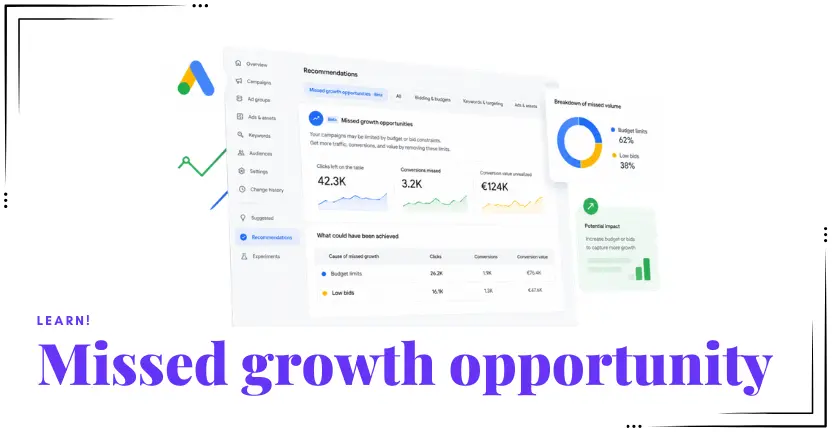
Google Ads is adding a missed growth opportunity beta to the main Recommendations tab. The feature estimates the clicks, conversions and conversion value advertisers may be losing because campaigns have limited budgets or bids.
What did Google Ads change?
Google Ads is making its Missed Growth Opportunity insights more visible.
The feature previously appeared as a tool inside Google Ads Labs.
It is now being integrated into the Recommendations tab for eligible advertisers.
The beta can show estimates for:
- Missed clicks
- Missed conversions
- Unrealized conversion value
- Whether the main limit is budget or bidding
The purpose is to help advertisers identify campaigns that may deliver more results with greater investment or stronger bids.
The recommendation appears beside other Google Ads optimization suggestions.
Not every advertiser may see it immediately because it is still a beta for eligible accounts.
What does missed growth mean?
A campaign can lose potential traffic when its budget or bids are too low to compete in all eligible auctions.
A budget-limited campaign may stop or reduce delivery after spending its daily allocation.
A bid-limited campaign may enter fewer auctions or lose placements because Google predicts that the bid is not competitive enough.
Google Ads already provides signals such as:
- Limited by budget
- Search lost impression share due to budget
- Search lost impression share due to rank
- Bid strategy status
- Budget recommendations
The new beta attempts to translate these limitations into more direct business outcomes.
Instead of only saying that a campaign lost impression share, Google may estimate:
- How many more clicks could have happened
- How many more conversions could have happened
- How much extra conversion value could have been generated
This language is easier for budget owners to understand.
However, it can also make the recommendation feel more certain than it really is.
Why should advertisers care?
Budget allocation is one of the most important paid-search decisions.
Many accounts contain a mix of:
- Campaigns that need more budget
- Campaigns that need better targeting
- Campaigns with weak landing pages
- Campaigns producing low-quality leads
- Campaigns that should be reduced
The new estimates may help identify where a budget increase could create additional value.
For example, two campaigns may both show “limited by budget.”
Campaign A may have strong conversion rates and profitable sales.
Campaign B may have weak conversion quality and poor return.
The missed-growth estimate could help the advertiser prioritize Campaign A.
This is useful for:
- Agencies
- In-house paid media teams
- Ecommerce advertisers
- Lead-generation businesses
- Companies with fixed monthly budgets
It may also help marketers explain budget recommendations to finance or leadership teams.
A statement such as:
This campaign is limited by budget
is less persuasive than:
Google estimates that the current limit may be preventing 40 conversions and $12,000 in conversion value.
The second message is more commercially meaningful.
It is also based on a model, not guaranteed performance.
Why are these only estimates?
Google cannot know with certainty what would have happened under a different budget or bid.
The platform must model the possible outcome using signals such as:
- Historical conversion performance
- Auction demand
- Search volume
- Competitor activity
- Bid strategy
- Budget pacing
- Conversion values
Actual results may differ after the budget changes.
A higher budget can sometimes reach weaker traffic.
The first group of clicks may come from the strongest queries and users.
As spending expands, the campaign may enter:
- Less relevant auctions
- More competitive auctions
- Different locations
- Different times
- Lower-intent searches
The additional conversions may therefore cost more than existing conversions.
Advertisers should treat the estimate as directional evidence, not a promise. Search Engine Land also warned that the figures should be validated against first-party performance data before budgets or bids are increased.
What should marketers verify first?
Before accepting a missed-growth recommendation, advertisers should check the underlying campaign.
Conversion tracking
The estimate is only useful when conversion tracking is accurate.
Review whether the campaign is counting:
- Purchases
- Qualified leads
- Form submissions
- Calls
- Page views
- Duplicate actions
A campaign may appear valuable because it counts weak or inflated conversions.
Conversion value
Ecommerce advertisers should check whether revenue values are accurate.
Lead-generation advertisers should avoid assigning unrealistic values to every lead.
Profitability
More conversion value does not always mean more profit.
Consider:
- Product margin
- Discounts
- Shipping
- Returns
- Sales-team costs
- Lead quality
Search terms
Check whether the campaign is already attracting irrelevant queries.
More budget could scale the problem.
Landing pages
A campaign with poor landing-page performance may need conversion improvements before additional spend.
How should advertisers test it?
The safest approach is to use a controlled increase.
Do not immediately accept the maximum suggested budget.
A practical test could involve:
- Select a campaign with strong tracking.
- Confirm that it is consistently limited by budget.
- Increase the budget gradually.
- Keep other major settings stable.
- Compare results before and after.
- Review marginal cost and conversion quality.
Important metrics include:
- Additional spend
- Additional conversions
- Cost per incremental conversion
- Conversion value
- Return on ad spend
- Lead quality
- Profit
- Impression share
The key metric is not the average performance after the increase.
It is the performance of the additional budget.
For example:
- Before increase: $10,000 spend and 200 sales
- After increase: $12,000 spend and 220 sales
The extra $2,000 generated 20 sales.
The marginal cost per sale is $100, even though the total account average remains lower.
This helps marketers decide whether the additional spend is worthwhile.
When should you ignore the recommendation?
A missed-growth estimate does not always justify higher investment.
Advertisers may choose not to increase budgets when:
- The campaign already has weak profit
- Lead quality is poor
- Inventory is limited
- Customer support cannot handle more demand
- The landing page is broken
- Conversion tracking is unreliable
- The business has reached its budget limit
- Another channel offers better marginal returns
Google Ads recommendations are designed to improve campaign outcomes within Google Ads.
The platform does not fully understand every business constraint.
For example, Google may estimate more conversions, but it may not know that:
- A product has low stock
- The sales team is overloaded
- Customer acquisition targets have changed
- Cash flow is limited
- Returns are high
Human business judgement remains essential.
What is the wider context?
Google has been adding more automation and predictive recommendations to campaign management.
Advertisers increasingly receive suggestions related to:
- Bids
- Budgets
- keywords
- Creative assets
- Campaign types
- Conversion tracking
These recommendations can save time and identify opportunities.
They can also push advertisers toward greater platform dependence.
The strongest teams use recommendations as inputs, not instructions.
They compare Google’s estimate with:
- GA4
- CRM data
- Sales records
- Profitability
- Inventory
- Business targets
This creates a more complete decision.
Google also introduced a separate update on July 21 allowing advertisers to bulk link several Google Ads accounts to one GA4 property. That change may make measurement administration easier for agencies, franchises and enterprise accounts.
What should advertisers do next?
Eligible advertisers should review the new estimates, but avoid applying them automatically.
Use the feature to build a shortlist of campaigns that may deserve further analysis.
Then ask:
- Is the campaign profitable?
- Is tracking reliable?
- Is the traffic relevant?
- Can the business handle more demand?
- What is the marginal cost of growth?
- Does another campaign deserve the budget more?
A strong workflow is:
- Use Google’s estimate to identify an opportunity.
- Validate the campaign using first-party data.
- Run a controlled budget or bid test.
- Measure incremental results.
- Scale only when the additional spend remains profitable.
The missed-growth beta can make budget planning more practical.
Its value will depend on how carefully marketers test the estimates against real business outcomes.